Wednesday, 20 November 2013

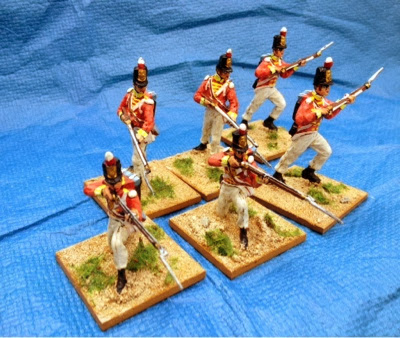
AOE 20mm Spanish Napoleonic army


The Spanish Napoleonic army is one of those nice wargaming armies that is seldom represented on shelves or tabletops.

This is mainly due too the misconception of a poor performance on the battlefield. Not only that is incorrect as the Spanish army achieved some astonishing victories over the French such as Baylen in 1808. 

History aside you have one nice thing if you model this army: a pretty good looking collection of models with a great variety of uniforms and equipment that will never make you tired of painting and modelling more and more units.

I used mostly the ESCI Prussian 1806 figures for the infantry and several other ESCI boxes for the cavalry. When I use other brands I will let you know in the text.

The flags are Web prints, mainly Warflag. Some others are hand painted and others are downsized prints from photos of the real thing, like the flag of the Walloon Guards.


The Regimento Princesa is made mainly from the Airfix AWI figures with X-Acto doing a lot of damage.


 The cloth on the back of the Granaderos cap is made from paper, after cuts on the cap itself.
 

The Regimento de Guardia Walona is ESCI mainly with some Airfix French Grenadiers for the Granaderos.


Regimento Sabóia (front row), Reina and España (back row). ESCI and Airfix figures.


The Regimento Guadalajara is made of the usual Airfix AWI with Fusileros from  ESCI Prussians and Italeri French 1805 infantry box.


The back of the Guadalajara Granaderos cap.


The Regimento de las Ordenes Militares, a mixed Airfix and ESCI unit.


Back of the Ordenes Militares Granaderos. Once again paper cloths on the back of the caps.
 

The cavalry is aproaching...
 

Lanceros de La Mancha. These are ESCI Polish lancers with ESCI Austrian heads with Greenstuff crests.


The Regimento Almansa are ESCI bodies from the Scots Grey box with Airfix AWI heads.

 
The same Almansa regiment, this time dismounted.
 

The Regimento de Olivenza; ESCI bodies with Tarletons from the ESCI British horse artillery.


Same idea as before for the Dragones de Granada.


 The Hussares Españoles are straight-from-the-box ESCI British Hussars.


The Regimento Rey is again ESCI bodies with Airfix AWI heads.


Now for the non-line infantry: the 2º de Voluntarios de Granada are ESCI bodies with paper and plastic hats.


Two regiments of Voluntarios de Catalonia from HAT Spanish Guerillas box.


The 2º Infantaria Ligera de Aragon is an all ESCI unit.


The Artillery is Airfix French with heads from the AWI. The Ox limber is made of two metal 1/87 scale oxes stollen from my father HO train table.


And that's it...
Thanks for watching.


Thursday, 14 November 2013

Pineapple Miniatures - 1/32nd scale Portuguese artillery - Buçaco 1810


Latest additions for the Buçaco museum:

The ACTA 9 pdr gun manned by four ACTA crew. 

Originally these figures are Waterloo British, but with a few carved out details and some putty they become Portuguese artillery for the 1810 campaign. 


Friday, 8 November 2013

Rapid Fire! 20mm, French Army 1940, Pt 5, French artillery


Back to BleuVille again and to its blue pastures.
This is what I've got up to the moment in terms of French 1940 artillery.


The goal is to have two battalions of 75mm guns (still 4 guns missing, hopefully solved when the HAT box arrives), one  battalion of 3 155mm GPF (2 missing that will be made from another two barrels of Esci M-12 SPG) and the already made 105mm Schneider battalion.


The 75mm are metal IT Miniatures with ammo trailer and crew from Irregular Miniatures.


The 155mm scratchbuilt model of a previous article with plastic transformed crew.


Again the same for the Schneider battalion. Crews are Revell and Airfix.


The Lorraine's were used as ammo carriers. I use these ones for the Char B1 Bis battalions, but I forgot to picture them with the tanks, so here they are now.


Saturday, 2 November 2013

Pineapple Miniatures - 1/32nd scale conversions for the LLL and theBritish Line infantry


This post is about some changes I made on the A Call To Arms (ACTA) Belgian infantry equipped with the Belgian Shako (based historically on the Portuguese Barretina) in order to produce Stovepipe equipped infantry.

This happened because I quitted waiting for the ACTA British Light Infantry, equipped with the Stovepipe, from my normal supplier.


The Belgian Shako had the cords taken out with a X-Acto and GreenStuff was modelled to the back part of the Shako and a pompon was placed in the front.


The Loyal Lusitanian Legion was a unit present at Buçaco that used the Stovepipe as it had been equipped in England.


Here they are with the correct headdress.

 The ones I painted before were wrong and the best I could do was to paint an old model of Barretina used in 1808.


Using the same changes you can also produce the British line infantry as these 88th Connaught Rangers. 

The only few other small extras are the woolen shoulders also made in GreenStuff.


Sunday, 27 October 2013

Rapid Fire! 20mm, French Army 1940, Pt4, 155mm LPF or the tales of a dog and it's influences on modelling


Some 20 years ago I had a beautiful Epagneul Breton called Breque.

I liked this dog so much that if he had lived today I would have made a blog just for him.

When he was growing, along with his teeth, I captured him chewing a row of newly painted Esci Churchill, Sherman and M-12 155mm howitzers.

I had prepared another breakthrough on my Normandy front, this time - stupid me -  on the floor of my basement. This Tiger tank... sorry, my dog destroyed a dozen or so allied plastic machines ( I should have changed the dog's name to Michael Wittman) and the only thing I could retrieve from the battlefield was a 155mm barrel of a M-12. 

Funny enough the German defenders were untouched which makes me believe that this dog was pro-Nazi.

I kept this barrel for years on the many storage boxes we all keep just wondering that one day it may be it's time...I didn't even know that this gun was the original GPF 155mm gun used by the French in both world wars. 


This is the surviving part from Breque's raid, gloss varnished as I used to do in those days. 


The carriage of the gun was made from two Irregular Miniatures metal wheels from their Useful Gun range, two thick Evergreen rods carved to shape and the central carriage part of a 5,5 inch Airfix gun. 


The gluing of the different materials - plastic, painted plastic, metal - became troublesome and hot glue had to be used in order to put together what was becoming a true mess...


After priming you can see more clearly the Evergreen details using plate, tube and rod of different sizes. 

The semi trailer is also based on a pair of Irregular Miniatures wheels.


Evergreen again in all small details. This material is an absolute must on modelling and it's also used on the making of the masters of many brands.


The gun and semi trailer are attached to a plastic base for its final form.


This is the third LPF in my collection: a French WWI, a German captured one and the subject of this post.


The WWI French is a beautiful Alby kit with Irregular Miniatures crew. This kit was the basis for all calculations on the other LPF building process.


This one is another scratch built effort this time based on a barrel extracted from a Rocco 1/87th scale M-40. It represents Sword beach "Daimler" battery. 

Both the gun and the crew have detachable stands.

Next: ...something else!


Saturday, 26 October 2013

Lussonium Roman camp- Hungary 2013


The Lussonium Roman camp,  near Paks, Hungary, is a very rare and interesting place. There you can see a border military Roman camp (Tabor) facing the land of the Sarmatian tribesmen.

This camp could be the home of some 1000 men, about a quarter of a legion.


The Roman camp of Lussonium is on top a hill and at the entrance there is a reconstitution of wooden gates surrounded by a ditch 2 meter deep.  


At the end of the 500 metres long camp there are still some stone structures: latrines ( in which the legionnaires faced each other, and could place the conversation up to date...), barracks and administrative services.


To the south you can see the area occupied by the civil camp.

 
At the Lussonium museum you can see many roman artifacts from the Pannonia of the III and IV century D.C and also some nice dioramas of the Roman fort, this time with the most probable stone look.


From the hill where Lussonium camp stood you can see the barbarian lands of the Sarmatian tribes, a beautiful landscape enhanced by the autumn colours. 

 
Nearby passes the Danube, one of the most iconic and beautiful rivers of europe.

Tuesday, 22 October 2013

Rapid Fire! 20mm, French Army 1940, Pt 3 - Building Schneider 105mm guns

 
 The idea is to build a battalion of French medium artillery with the 1913 Schneider 105mm gun.
 
In order to build it from scratch you need some good reference books/internet images and articles; that box of parts you kept for years without never knowing exactly what to do with it; Evergreen tubing, rod and plate; pencil; X-Acto; plastic glue and superglue and one of those rainy weekends in which you only think LET´S DO IT... whatever it may be...
 

You also need to find the correct lenght of the gun (9 cm lenght) so you can work more freely inside it, without too many worries about this or that half milimeter,  something that the late Dave Howitt tought me.

According to Dave Howitt the most important thing on building a wargames piece was sturdiness and the enhancement of the main details, avoiding flimsy parts that will self destroy with use.

First you build the barrel out of Evergreen. One of the barrels was taken from the Airfix 5,5 inch gun after some shortening.


The carriage is also Evergreen and its the most difficult part of the gun. Be careful measuring this one.


The irregular shape of these parts is challenging, but if you do it carefully you can have a very reasonable Schneider carriage. Bend the carriage in the middle to produce its characteristic shape.


Glue the carriage to the barrel and you will have the gun in a skeleton shape.
 

Then start to add more details as the back cover of the carriage and filling the carriage with other thin stripes of evergreen until you feel satisfied. You can avoid this trouble if you have the correct length of Evergreen rod, which I didn't.


Its wheel time: I used a pair of Britannia metal and two of Emhar´s plastic from its 18pdr.


The gun shield was a true headache (the ones we like...) as this gun had a multitude of different shields varying from time and country. You need careful planning in this one too!
 

After assembling the two part shield dip the bottom part in very hot water and bend it to shape, as this kind of shield was slightly curved. Evergreen works well with hot water. Then quickly dip it again in cold water for final shape.
 

Add last details, specially at the back part of the gun.
 

Finally place two very thin stripes of Evergreen along the shield.
 
 
And here you have it: a cheap three gun battalion of 105mm Schneiders for the 1940 period.
 
Next: crew, painting... and who knows what else...