Showing posts with label Altaya. Show all posts

Saturday, 15 November 2025

Able Archer/ RFR rules (?) - Russian invasion of Ukraine 2022 in 20mm (part 15) - Ukraine turns (more and more) to Europe


With Trump/US weapons having to be paid for almost a year by now, Ukraine shifted almost completely to free European weapons. Its the case of the Italian B1 Centauro (November 2025) and the French VAB (already since late 2022)  and Mirage 2000-5F (February 2025). All models are repainted Altaya die-casts.

While the vehicles were easily blackwashed, dusted and some markings added, the Mirage 2000 was more complicated with the erasure of the French markings and the painting of the tricky Ukrainian markings. Fortunatley they left the camouflage as it was and forgot the geometrical greys! Also a pilot was inserted in the cockpit. 

The problem with nowadys vehicles in Ukraine, both Ukrainian and Russian is the anti-drone protection that really I still didn´t figure out how to do in a simple and speedy way to both fleets. 

Next: the 3rd US Marine Battalion for the Pacific.

Sunday, 9 November 2025

RFR/Able Archer - The Iraqi Airforce in 1/72nd scale


This one started to be built during the Gulf War itself as aircraft were some of the miniatures available to portray Iraqis. The vast majority are plastic model kits with a few more recent Die-cast.

Monday, 3 November 2025

RFR/Able Archer - The Iraqi III Army Corps support


This is the last video for the ground troops of Saddam in Kuwait. There is artillery, reconnaissance and some navy for the famous southern Khafji landings. The usual brands are Cromwell, Skytrex, Irregular Miniatures, Altaya with the usual scratch building with help from many other brands.

Monday, 27 October 2025

RFR/Able Archer - The army of Saddam Hussein in Kuwait 91 (part 2), the 5th Mechanized Division


One more division of the Iraqi III corps. This one, the 5th Mechanized Infantry Division Mohammed Ibn Al-Kasim, is another famous big unit of the Iraqi army with participations in the last three wars of the country, the Iran-Iraq War, the invasion of Kuwait and the US invasion of 2003. I became interested in this Division after the opening of the ground war in the 1991 Iraqi Khafji offensive were the 5th MID had a central role. It was equipped with different models of the T-55 series and APCs (in fact Chinese T-59 and K-63). Still a few heavy mortars are missing as well as some tractors for the artillery.

Saturday, 18 October 2025

RF! in 20mm - A little known armoured encounter somewhere in nowadays Pakistan, the battle of Al-Lie


A little known armoured battle of WW2 happened in Pakistan (some sources say it was Afghanistan) at a place called Al-Lie, between several units of armoured vehicles of Japan, Germany, Slovakia on one side and USA and USSR on the other:

- The Japanese got lost in the jungle looking for the body of Yamamoto and ended up a bit to the west;

- The Slovaks found the Eastern Front too dangerous and a task force derived a bit more to the south east looking for more peaceful areas;

-The Germans had to be in control of everything Axis;

- The Soviets, without radios on their tanks, got lost and now were too scared to return because of NKVD thinking they were deserters;

- The US simply had to be everywhere even if it was not their damn business!!

Two conclusions are known about Al-Lie battle, no one survived to tell the story and it didn´t happen. 

After this BS story what really made me making this bunch was the fact of having these models sitting for too long on the cue and all were WW2 bits for continuing a number of armies. 

The one waiting for longer, maybe 10 years, and already built (given by JF or JMM) was this Esci late KV-1 that will go the winterized Soviets. 

This Mig T-28 is one of the oldest model kits of this tank, dating from the mid 90s. I found it in one of the last model shops in Lisbon, the Casa Antunes. 

The model is a piece of hell to be built as it is made in resin and lots of photo-etched parts and thus made for standing in a shelf and not wargaming. But as I´m a shelf wargamer everything will be OK. 

Two more T-35 monster by S-Models. Only four to reach the 10 mark as ordered by Master Colin and Richard in its supplement for Russian units 41-42. In fact the 8th Mechanized Corps used them at Dubno, which is my target for Barbarossa. The last four will not have the aerials as they only existed in the command tank of the company. 

This "Long Tom" and HST is a second one to be built and is the consequence of an exchange made years ago between a full Altaya collection and some miniature racing cars. A Matchbox figure and a base was added, a quick glass paint and sand color drybrush and its ready to go. 


Some 10 days ago or so I received a nice parcel from a Spanish wargamer friend, JZ, which had plenty of very helpful bits and pieces. Among them there was this Horch 830 radio car of the early war period, probably by the extict BUM and copied from the Wespe model. The aerials were added and a few more details also. 


Not sure about this aerial arrangement but it looks nice to me. 


Also from JZ came all these that went for the Japanese. The Sumida Type 92 armored car is resin a copy of the Skytrex one I already have. I painted it with the same SNLF colors. The truck to the left pretends to be a Nissan 80 but it started as...


... a firemen truck. Here it already got some plastic side pannels to look more like a cargo truck...


...and here it got new wheels and a tarpaulin. 


These diecast pickups started like this but here you can already see the final arrangement with hot glue on the windshields, new wheels and cargo to disguise the strange stuff on the back.


Three more Praga trucks from FtF going to the Slovak Fast brigade. 


And three more Slovac LT-35 to conclude the armour of the same brigade.

Next: another video on the Iraqi 1991 army

Thursday, 16 October 2025

RFR/Able Archer - The army of Saddam Hussein in Kuwait 91 (part 1), the 3rd Saladin Armored Division


This one is really heavy. Not only in the amount of armored vehicles but also because most of the vehicles are Skytrex metal, true shelf benders. This division was the most famous of the regular army (not counting the Iraqi Republican Guard) and fought several wars from 1973 up to 2003. Its armored and mechanized brigades fielded plenty T-72 and BMP-1 and the artillery was crammed with 2S1 and 2S3 systems, which, for those days were quite potent weapons. During Kuwait War the 3rd Saladin opened the ground war with the coalition with the attack on Khafji, together with other units of the Iraqi III corps. Most of the information for making this division was taken from the excellent article on Millitary Modelling Vol.30 No08 by Cookie Sewell.

Sunday, 5 October 2025

Rapid Fire!/ Able Archer, The Gulf War in 20mm - The French made AMX -30 AuF1 of the Iraqi Republican Guard


These models come from the excellent Altaya range. I ended up with a total of 12 of them, with 6 going to the IRGC (Iraqi Republican Guard Corps) and the other 6 going to one of the Gulf War enemies, the Saudis. At the beggining the RF system was giving two pices of artillery per battery but recently I´ve noticed a decrease with just one model representing the whole battery. So like this you can have one or two battalions of artillery. 


The IRGC apparently got all of the 85 (some sources say around 70) of these artillery systems and they seemed to have mostly survived the Iran-Iraq war, 1991 and 2003 wars as rows of them were present at Camp Taji, Baghdad, after 2003. Probably they were at rear echelons in the 1991 ground battles (even if some show up abandoned/destroyed) and around 2003 they were missing spare parts and became immobilized. I painted the red triangle of the IRGC on both sides of the turret without being sure it was there. I saw modellers painting these but with the top white part painted grey. 
The good thing of having these together with BMP-1s and T-72s of the Saladin AD is to quickly put together an armored or mechanized RG divisions like the Hammurabi, Nebuchadnezzar, Medinah or the Tawakalma . 


Another possible type of markings is this one as seen on a Hammurabi AD vehicle, a photo I´ve found after finishing this lot.


The models were repainted Vallejo Iraqi sand as usual and changed with the addition of EverGreen plastic side skirts, stowage at the turret rack, antenna and a Soviet AA machine gun. 

Next: a big brawl of WW2 tanks between the Slovaks, Soviets, Japanese and even the Americans. 


Friday, 8 August 2025

Guadalcanal 1942 in 20mm for Rapid Fire! rules - (Part 2) The Japanese tanks


This group was initially planned for the whatever tank encounter of the Pacific from Khalkin Gol to  Saipan or even the last few Battles with the Soviets in 1945. In fact the tank duels in the Pacific, or even a large armored assault by the Japanese, was not a very common sight, specially compared with the Western theaters. In the meantime, Guadalcanal entered as a solid project, and upon reading on the issue, the two main Japanese tank assaults of this campaign (Tenaru and in one of the several actions on the Matanikau) only had between 6 to 10 tanks (Ha-Go and Chi-Ha models) each as the Japanese on the Island(s) were an infantry force with just a few tanks. 
So, besides Guadalcanal, this force allows for pretty much everything you need in terms of Japanese tank actions. 


This Type 89 Chi-Ro is a 3d PLA print from MiniGeneral. This is the type of early tanks used in relatively large numbers which makes a few more necessary.


This one is my most recent Japanese tank with all others made already years ago. As this Chi-Ro is an early version I changed it into a later version with a turret that can be opened and a metal crewman (CP models , I think). 
 

This Type 93 Kokusan by Skytrex was also an early reconnaissance vehicle and, up to now its the only one I have. Maybe Wargaming China can send me few of his Japanese unique and fabulous armored cars? After all that would strenghten the commercial relation between the two neighbors, Portugal and Australia. 


The early mediums Type 97 Chi-Ha with the smaller turret with short 37mm gun. The two to the left are Fujimi and the ones to the right are Airfix. The command version is the Type 97 Shi-Ki with a coaxial long 37mm from Frontline Wargaming.


The Type 97 Chi-Ha with the new turret housing a 47mm gun. The ones closer are Fujimi and the two on the left are Skytrex. On the back are two Altaya die-cast models. 


Again from Fujimi you have here two Type 1 Ho-Ni with 75mm gun and a Type 4 Ho-Ro with  15cm gun from Frontline Wargaming with Fujimi crew. 


The Type 95 Ha-Go is an essential both for Guadalcanal and Tarawa, the two Pacific settings I´m nowadays around. The Ha-go with crewman is Skytrex and the others are Frontline Wargaming. 


The tankette Type 97 Te-Ke and the Type 98 Ke-Ni (sucessor of the Ha-Go) are both Frontline Wargaming. 

The only Japanese artillery I have up to the moment are these two Emhar 75mm model 38 improved (in late war green and not  Artillery Brown as they were originally painted after seeing "Flags of Our Fathers" a late war story) towed by two Frontline Wargaming Isuzu. The crews are conversions from Fujimi and Airfix. 

Next: Whether a video on the Confederates at Gettysburg or the Japanese infantry of WW2. 

Sunday, 27 July 2025

Able Archer/ RFR rules - Vietnam in 20mm (part 12) - Armored vehicles for both sides


In this FOW style picture, were tanks point at point blank range to each other as if coming from holes on the ground, you have the two missing Sheridans, 2/3 of the necessary M113 ACAVs (both types of models for the 11th ACR), a M42 Duster, just because it was on the stash, and the first few T-34 and T-54 for the NVA. 


The ACAVs are Eskice, printed in Germany by Tom Hobby. I continue to be amazed by these resin 3d printed models as this, for instance, has two pieces, one being the 12,7mm HMG turret, with gun and figure, and the other, well, all the rest, including figures...
I already had some Eskice in the form of six German WW2 side-cars and enjoyed painting them a lot even if they have big heads which doesn´t make them good neighbors for most other brands, exceptuating the sort of the old Britannia metal figures. 


With three more, the full ACAV numbers will be achieved for the 11th ACR. 


Only a few jerrycans, antennas and some stowage was added. 


I made a small raid into the box were I have the 1st group of 4D models. They are around 30 (some 1/72ish, others 1/87th scale) and, if I can remember well I could only use some 4-5 of them (heavily converted, though) as they are toys and not real models, with the bottom part, including wheels, being all the same throughout the collection. The M42 Duster is no exception. But by looking at a comparison on the web between the Altaya and the 4D M42 Duster, I realised the top part of the 4D model is quite reasonable. 


What the 4D model mostly needs is some new wheels that came from derelict Hasegawa M24 Chaffees, glued against a piece of thin cardboard as they needed to be a bit far from the bottom part, which is the same on all 1st series 4D models. Then some crew, stowage, antennas and a HMG were added. 


The Atlantic crew figures lost their heads  as they were too small and were replaced by Hasegawa pilot´s. 


The Sheridan to the left is Airfix and the other is Altaya. They got the same treatment as the first I made a few weeks ago. Now there is one per squadron for the 11th ACR, which is the intended number. 


For painting all these vehicles I followed my first Altaya Vietnam models procedure: the Altaya Vietnam models (Gun Truck, M41 Bulldog and M48A3) came painted in olive brown with the usual sheen of Altaya vehicles; in order to break that sheen I slightly sprayed Krylon's Panama Khaki, which is something I continue to do with all models from other brands for this theater (the olive brown used is Vallejo). In period pictures, Vietnam models are many times covered in mud due to the rainy seasons. This in fact saves two moments of painting, the black wash (which needs a few hours here - days, in England, he,he) and the main color + white drybrushing. 
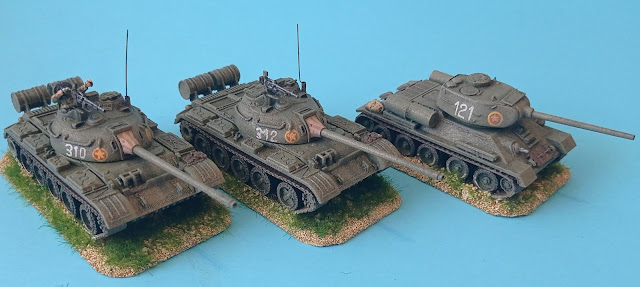
Finally a few NVA tanks. The T-54 are 4D models and are a big improvement from the first batch they made, from were the M42 Duster comes. I already made a few of these T-54 for the Angolans and knew how good and easy to build these models are. The T-34 is Polistil, and together with the Airfix Sheridan belong to a small batch of models found in the last month´s flea market at Tomar. Next week I plan to be there again for some extra old findings.

Next: wether Vietnam or WW2 aircraft. Guadalcanal is also close. 

Monday, 30 June 2025

The USAAF and the RAF in mid/late WW2 for Rapid Fire! rules and in 20mm ...


This one shows the Allied aircraft for both the Pacific and European fronts. Its another collection that mixes decades old models with an Avro Lancaster finished last night. The usual plastic brands are acompanied by Luppa and Altaya die-casts. This post concludes the WW2 aircraft from the major participants as smaller countries like Poland and Slovakia have their aircraft shown while showing the rest of the army.

Thursday, 26 June 2025

The Japanese IJA and IJN aircraft in WW2 for Rapid Fire! rules and in 20...


The Japanese airforce of WW2 is an old pleasure of mine and, together with a Tarawa wargames table and a few Japanese tanks and US Amtracks, its the only few things I have for the Pacific. The models are Hasegawa, Fujimi (most of them from the good old days of cheap Japanese models), Airfix, Matchbox, Italeri and Altaya. If you want a detailed post on how I built the Ryujo Aircraft Carrier go to https://jpwargamingplace.blogspot.com

Sunday, 22 June 2025

Rapid Fire! IJN Ryujo Aircraft Carrier in 20mm


Since finishing the Attacker/Bogue class aircraft carrier I wanted something similar for the Japanese. Maybe because I was around Vietnam models lately the interest of making a Japanese aircraft carrier finally rose. Again the problem of these things is size as they would be several times bigger than this in 1/72nd scale. I chose the Ryujo for being one of the smallest of the 18 different aircraft carriers Japan had in WW2. Smaller then the Ryujo only the Hosho, but this one was kept as a trainer and survived the war with minor damage only to be scraped in 1946. The Ryujo on the other hand was sunk in the battle of Eastern Solomons on the 24th of August 1942. 


The Ryujo was called the "illegal aircraft carrier" as it was built small and light in order to exploit a loophole in the Washington Naval Treaty of 1922. This caused problems as it became top-heavy and its ship-like format at the lower deck made tons of water to enter which caused electrical and engine problems. Like this Ryujo suffered several modifications in 1936-37 and 1939-40.


Making a reasonable card bow on a model ship is always complicated but finally this one came out. The round windows were made with a paper punch on thin card paper. Some necklace thread was used for the anchor. The commander´s cabin became a bit small as I placed the radars a bit above were they should be covering what should have been a larger window area. 


The 23mm dual guns were made from Atlantic HO guns older than me. The crew is also Atlantic and a quick paint job on these Italian modern figures makes the part.  


The same for the much larger 127mm naval guns. Due to laziness I didn´t glue any detail on the cabins and just painted some details. 


The funnels were made from electrical PVC tubing with a plastic grid


The "Airfix" stern had some Airfix dinghies, Airfix WW1 tank wheel parts and an older paint mixer. It was kept simple as its a very complicated area of Ryujo to be made accurately.


In the end this model is 85cm long when it should be 2,5 meters long in 1/72nd scale. Obviously you have to compromise between a reduced model and being kicked out of the house. So these kind of smaller aircraft carriers (and then heavily reduced in RF! style) are the maximum that can be done in wargaming terms. Only the more fortunate of us with endless space can aspire to make Akagi, Shinano or USS Enterprise with around 4 meters each! 


As a proof of the shrinkage effect - if its necessary - the guns on the model are 12 tubes while the original one had 24. 

In fact one of the interesting things about Japanese aircraft carriers was its camouflage. I wanted to portray a carrier with the dazzling effect of Japanese carriers but that turned impossible as, while reading on the subject, I found that only a few of the carriers really had that sort of camouflage. So this one ended grey like the real Ryujo. 


This is the true Ryujo size, something that dwarfs my model. 


I started with a simple layout of the model to calculate the relative position of the gun's bays and other larger details, the landing deck, height and overall design. 


The base and upper upper deck were cut from platex and the two bottom halves were cut from 3 millimeter cardboard. 


The middle deck was placed with the help of two vertical reinforcing squares of cardboard. 


Beams of wood were used for securing the upper deck. 


The life boats were made from pieces of carved blueboard. 


The 127mm guns had the side and support structures made from blueboard. There is one of these guns per box so eight boxes of the heavy artillery set of Atlantic had to be opened and coupled. 


The small radars (in red) were made from whiteboard markers. 


If done today I would have extended the bow some three more centimeters and the upper deck would get two more centimeters in  width. 


Also the lower deck should have had some two centimeters less in height. Even so it became a reasonable model for wargaming. Even if, obviously, will never wargame as intended in the Washington Naval Treaty of 1922 :)

Next: The Japanese aircraft in video