Showing posts with label El Alamein 1942. Show all posts

Saturday, 20 July 2024

Rapid Fire! rules - Bir Hakeim 1942 (part 5) - Company trenches


Essential for any defensive position are company trenches. Once again they were made for Bir Hakeim but with an eye on other scenarios. In fact I can´t find many defensive positions in Bir Hakeim protected with sand bags as they probably could be targeted more easily due to their  recognisable shape. 


The idea is to make trenches with a rear dugout protected by some wooden plaks and enough space at least for eight figures (  four bases each 2,5cm X 3,5cm).  


Once again carved RoofMate was used glued to plywood. 


One of the trenches got a Vauban shape...


...while the other four are straight with the usual dugout. 


The small stones around the trench helps to shape the piece and also gives some weight helping not to deform it. 

Next: Les Mamelles of Bir Hakeim

Saturday, 13 July 2024

Rapid Fire! rules - Bir Hakeim 1942 (part 3) - First set of fortifications


Unfortunately I still don´t have a good reference book from where I can get somecomplete images of the French defences at Bir Hakeim. Fortunately, the Web gives some help and you can make Bir Hakeim  as if you are building a puzzle. My initial idea was to make larger pieces of terrain integrating trenches, walls and revetments but instead I´m making individual pieces, due to the lack of  information. Later it can be put together in a correct way when more information is available. The only good thing about not having precise information is that you have to go generic in many of the terrain features allowing it to be used in other scenarios. 


The Turkish fort was built in blue board, as most of the stuff you can see in this post. There are some nice images from Google Earth that you can use for the generic shape. I kept it on the small size for not to dwarf other terrain features. 


Small pebbles help a lot in this kind of terrain where most of the features were neglected and ruined. 


Th small wall at the top is my imagination but some sort of walls must have existed on top of it around May 1942.  


There is a set of walls around the fort and the curved one was built  specifically for it. 


This view from the fort shows what I tried to achieve. 


In this after the battle photo you can see the the Turkish Fort at the top left corner and the famous house (blockhouse?) that shows up as soon as you google "Bir Hakeim" (not the Parisian station). 


Again Blue Board for this one. The 4cm thick board was sliced into parts a bit thicker than 1cm in order to make the walls. In fact you can have this kind of size in DIY stores but I just used what I have at hand. 


After painting the house with ochre colors I applied some hypothetical diluted white paint on parts of the structure. 


This type of trench can have some 1/2 battalion inside and some eight are necessary for the entire four battalion´s defence. 


The 4 cm thick blue board was reduced to around 3 cm and divided in three parts for better and easier carving.  


After texturing the piece with a mix of cat litter and fine sand the two component paste sand bags were applied. When everything is dry the sand bags got some super glue for extra resistance. Don´t do it on the blue board directy as the blue board will melt.


This set of resin walls and sand bags was given to me by my friend Mário Laranja and will be used in many places of the Bir Hakeim compound including the Roman water cisterns. 


The exception is the curved  wall on top that will be part of the Turkish Fort complex. 


Next: More Bir Hakeim or the 3rd US PIR for the 1944 campaigns.

Friday, 26 April 2024

Rapid Fire! Western Desert 1940-43 in 20mm - First New Zealand Battalion


Another battalion for the Western Desert and Crete parading this time in front of the captured Fort Capuzzo. And, again, an highly improbable one due this time to the lemon squeezer hats. Most probably the New Zealand infantry used always the Brodie helmet in action but modelling them with their cherished hat makes them distinguishable on the table and/or shelves.


For that I used plastic British from all sources with pinned heads from Airfix US WW1 infantry. Even if some are 1/72 and others are 1/76 they end up forming a realistic group . Well, not counting the hats, of course. StreletsR has a nice box of these guys if you prefer not to loose time converting them and piercing your fingers.


Here, (L to R) Matchbox, Esci and Airfix all living happily in the same stand. The Esci figure got a new head and also a new arm as the original is holding a pistol and something more administrative was necessary. 

Both mortars are scratchbuilt (the 3'' has a bipod from an airplane landing gear) with figures from all brands. The middle figure in the 2'' stand is the old Airfix holding a Bren. The ammunition magazine was carved out for the figure to look as if carrying an ordinary rifle. 


As an example this company is made of  figures from the Matchbox,  Esci and Airfix 8th army boxes and  Esci WW2 box. 

Next: Russian Tor systems to finish the BTGs AA groups. 

Sunday, 7 April 2024

Rapid Fire! Western Desert 1940-43 in 20mm - Fort Capuzzo


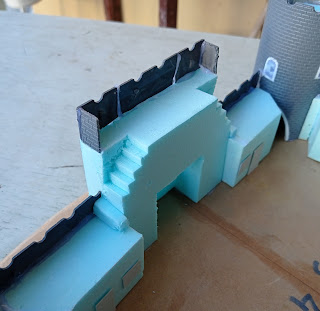
Fort Capuzzo was an Italian large structure in the Lybian and Egyptian border built in the 20s to prevent the passage of the Sanussi tribesmen. In WW2 it changed hands several times as it was placed right in the middle of most of the more important offensives from both sides.This fort has been on my plans for some time. I never had the Airfix desert fort nor any nice resin fort and I wanted something with the proper gate of Fort Capuzzo. At the same time the building should be used in other periods of history (more on that later) as it should be something like 40cmX40cm. In fact it ended 40cmX33cm, large enough for a RF battalion to be placed inside. 


While looking for Lego Bionicles for my 6 years old boy in a Chinese shop I found these 1 euro tower & walls from the Christmas period. I brought four of them and Capuzzo started to have a shape, at least on my mind. 


With the help of the cheap 1 euro models and BlueBoard the construction was an easy affair. All windows were covered with hot glue gun  and the whole structure was glued to plywood. Soon I realized that the turrets should have been much shorter but it was too late. 

The gates of the turrets were turned inside and some makeshift inner doors are suddenly possible.


The way other periods of history are possible for this fort is by making the inscription "Ridotta Capuzzo - Amseat- "in a piece of clear plastic... 


... and take it out whenever is necessary. The plastic piece just need to sit in some L shaped pin. 


The most recognizable part of Capuzzo was its gate and some work was placed on it. Even so I skipped many details for this structure to be as generic as possible. 


BlueFoam was used in most structures as its a resistant and easy to work material. 


The blue foam was carved with brick shapes to go along with the plastic of the original tower & walls models.


When building something like that you have the choice of building it in a pristine pre-war looks or with  some sort of damage. 


I went for the second and with the help of some plastic breaking, small pebbles and a hot glue gun something already destroyed was achieved. 


The fort was in fact not a single structure but a big number of dwellings and separate buildings and walls. 


I kept as simple as possible thinking also about placing some extra buildings inside and outside of the fort. 


The true Fort Capuzzo from the sky. The towers were more detached from the walls than in my  model and the number of buildings was simply too much to replicate. In the end, a couple of extra desert buildings inside and outside will do the trick. 

Next: maybe some WW2 Mediterranean New Zealanders. 

Thursday, 28 March 2024

Rapid Fire! Western Desert 1940-43 in 20mm - The last two battalions of the British Brigade (no,no, different post from previous one)


After the Aussies left the table from their photo shoot the Brits came in, so even if they look alike these are two different posts. These are the two last battalions for the British Brigade for the Desert 1940/43. This Brigade is the only one I have fully with the Brodie helmet, with all other Commonwealth brigades, Hindu, Scottish and Australian using their most known headdress (turban, Balmoral and slouch hats). The New Zealand is at its beginnings and they will be WW2 British bodies with lemon squeezer hats from  Airfix US WW1 infantry. 


As I generally do I mixed figures from brands that are similar in size. Specially the helmets, when of different scales (1/72 or 1/76) make figures very different when placed side by side. Here, Revell, Airfix copies and Hat are all mixed to a good effect. 


The only Matchbox and Airfix 1st version figures came together in the 2 and 3-inch mortar stands. When put together in the same stand they look ok with helmets of the same size. 


The 2- inch mortar was scratch built and its No1 operator was the Matchbox figure firing the Bren gun. The same happened to the Boys AT rifle operator who now has a 3d printed one. 


The command groups mixes all possible brands of the same size. 


A few LMG figures in the rifle companies have scratchbuilt Lewis replacing their Bren. It just gives them a bit of "Beau Geste" looks, maybe still up to 1940, but I think the British Infantry had them already fully replaced by the Bren LMG. Even so there may be chance of them being used by the infantry in the desert as many Bren were lost at France in 1940 and something had to be used instead.

Next: The New Zealand Brigade at Gallipoli 1915

Wednesday, 27 March 2024

Rapid Fire! Western Desert 1940-43 in 20mm - The last battalion of the Australian Brigade


Being lately around Gallipoli, and looking the figures with bush hats still to be made, I decided to make the last battalion of Australians for North Africa/Crete. 


Once more I wanted some bulky Aussies and so the Airfix Chinese copies and the Revell figures were used together with some 8th army figures of the same origin. Also a few more Hat and Revell Australians were added to the command and support stands. 


Also a Revell figure is manning the 2'' mortar together with Hat British on the Boys A/T rifle, a true Aussie from Airfix on the radio and an Esci Colonial British gave his body to an Australian head. 


The 2'' mortar and ammo container were made as usual from pieces of plastic card. 


The arm of the Hat Bren LMG figure was changed in order to hold a 3d printed Boys A/T rifle. I placed the laying down figures in a blob of glue gun for my mixture of sand and cat litter not to sink the miniatures. 


The other support stands came from a mix of Esci, Revell and Hat. 


The typical infantry companies had a number of head swaps. The Revell figures are bigger than the Airfix but they go well with the Chinese copies. 

Next: The two last battalions of the British WW2 desert infantry or the Gallipoli New Zealanders,