Saturday, 22 March 2014

Pineapple Miniatures 1/35th scale - Leal Legião Lusitana, British 52nd light infantry, French infantry - Buçaco1810


ACTA Leal Legião Lusitana made from the British light infantry box. The flags are the generic Dom João VI era flags. 


ACTA 52nd LI (avenge General Moore ...!).


Hat French coated infantry (Voltigeurs and Grenadiers). 

All this at the usual place, Museu Militar do Buçaco. 

Tuesday, 18 March 2014

DBR- Battle of Mohács 1526 (part 8) 20mm Hungarian household cavalry


Now for some Hungarian just out of the varnish spray.

Most of figures are Miniart Burgundians and French with some Zvezda French knights. 


Here is Ludwig II ahead of his household cavalry in that mad charge against the Ottoman center.

Take a good look at him cause he died some minutes later and may be the last time you see the young king.


In order to have balanced armies I'll make a group each time of Ottomans  and  Hungarians. 


The flags are colour photocopies of the ones I showed you in part 6.


Hungarian cavalry is great and easy to paint (as all Gendarme cavalry type) :

- black spraying
- apply some dry brush steel colour 
- and later aluminium colour. This will make the knights armatures shine and look cooler. 


The Zvezda horses are quite short in height and look a bit silly with its horsemen on top. That is strange for probably the best plastic small scale figure manufacturer ever.

On the contrary Miniart horses are tall and slim but all this mixed together makes a pleasant sight.

Truly speaking the ones I would like to have are the DDS XVI century knights but these suckers have vanished from the market as no shop seems to have them on stock. I think it was Suleyman...


Friday, 14 March 2014

Military Trakai (Lithuania), March 2014


Trakai castle is one of the most important places in Lithuanian history, a sort of Portuguese Guimarães. 


The area is incredibly beautiful and in this cold March the water of the surrounding lakes was frozen and could support the weight of a man in some places.


The eventual escape route for the king of Lithuania if necessary...


There are several maps of the battle of Zalgiris 1410 (Tannenberg) between the Lithuanians and the Teutonic Knights.
Here the Teutonic Knights were smashed and his Grandmaster Ulrich Von Jungingen was killed. 


Vytautas the great, the victor of Zalgiris and one of the most important figures of Lithuanian history.


Spanish influenced corselet. 


An influenced French armature.


A Lithuanian cavalry helmet of clearly (even more) eastern influence.


Lithuanian costume of the XV century.


The castle was destroyed as a retaliation for the 3rd Lithuanian attempt of taking Moscow (???). What today can be seen is a very well done reconstitution.


A late medieval bombard used mainly as a siege weapon.

Monday, 3 March 2014

DBR- Battle of Mohács 1526 (part 7) - 20mm Ottoman and Hungarian flags


The first group are some Ottoman flags for the Suleyman years taken from the web after a research by OB ( no she is not from Brigada Tripeira, she is Galatasaray).

The first is the Ottoman Battle flag; the other ones with the red field are the State flag and the green are generic Ottoman. 


The quality of the printing will not be the best as the phone camera resolution is not a great thing. 

If you want the real stuff send me an email to jpp681@gmail.com and I'll gladly send you the file.

The 1st page of Hungarian flags are suitable for the cavalry and are hand painted with acrylic, hence the scrubby look.  


The isolated flag in the next picture is the Ottoman Solak flag and should be used in a cruciform pole.

The next group of Hungarian flags already include some for the infantry, namely the last two which can be used for the Landsknecht.


After resizing you may print them at your will. Hope they can be useful. 

Wednesday, 26 February 2014

DBR- Battle of Mohács 1526 (part 6) - 20mm, first Sipahis painted


The converted Sipahis from two posts ago already painted.

These ones were conversions from Esci and Italeri with some extra details added.


The blue colours on most of these Ottomans vests were inspired on the Mohács movie I've showed you. There are many more available on the Osprey books and such. Search in the web for George Gush Airfix articles on Renaissance warfare. They are an excelent start for the period and mainly designed for wargaming.

The red flags are loosely based on the red flags of the Silâhtar Sipahis, one of the elite group of the household cavalry.

  
  A few extra were added like the Evergreen bow case...


... and an armoured chest protection    for everybody made out of painted Liquid GreenStuff and a turban from normal GreenStuff for one Sipahi per stand.


Saturday, 8 February 2014

DBR- Battle of Mohács 1526 (part 5) - Figures you can use.


These are the existing plastic for the Renaissance period and Ottoman Vs Hungarian (according to PSR site).

Ottoman:

- Orion janissaries.
- Zvezda cavalry.
- Zvezda janissaries.
- Lucky Toys Turks.


My Ottoman army will have all of these less the Janissaries Orion box as I could find two Zvezda janissaries boxes in Izmir, and c'mon, buying Ottoman soldiers in Turkey is really cool (in spite of Zvezda being Russian...). 

Hungarian (most approximate, as there is no Hungarian dedicated box ):

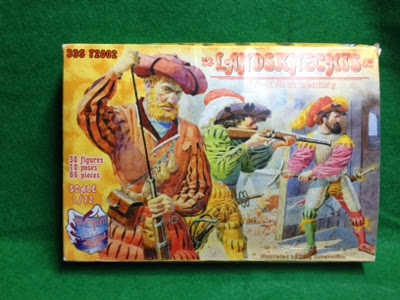
- DDR Landsknecht (2 boxes, one with pikemen and another with Doppelsoldners and arquebusiers).
- DDR knights  (apparently not in production).


All of this figures but the DDR knights will be on my army, and will be replaced by Miniart knights.

BUT, there is always a butt (and some of them are reeeeeally extraordinary...) you can use other boxes from late Middle Ages to make the large variety of different soldiers present at Mohács 1526: 

Non dedicated Ottoman boxes:

- StreletsR Muzlim Foot Warriors, Arab Cavalry and Turcopoles Cavalry for the Azab, Akinji, Balkan and Tartar contingents.


- Esci Muzlim Warriors for some torsos and heads both for Sipahis and artillerymen. 

(This is the IPSBLQHB (initially-pretty-stupid-but-later-quite-helpful-buying) I did at a supermarket for 1€ each. 

- Italeri Saracen Warriors for camels, foot Azab and horses. 


- Italeri Mongol Horde for tartars and Sipahi barded horses.

Non dedicated Hungarian boxes:

- Miniart Burgundian or French Cavalry as they are almost the same. 

- Zvezda 100 YW French Cavalry also have many lancers that fit nicely the Hungarian knights. 

- Zvezda 100 YW French Infantry, specially for the crossbows. 


For the Hungarian infantry I still have to look better both for arquebusiers and spear armed figures probably from Miniart, metal being the last resource.

This Mohács 1526 project will be mostly a job on the cheap side, with many boxes from the stockpile and conversions, and when this happens it's a particularly thrilling thing as what comes out is generally a collection of unique figures. 

Wednesday, 5 February 2014

DBR - Battle of Mohács 1526 (part 4) - converted Sipahis


One of the  first sources of figures for this Mohács project is a huge stash of Esci Muzlims I found some 10 years ago in a supermarket (???) in Covilhã, a city close to the Spanish border.

There were 15 such boxes, all the same, and at an irresistible 1€ each as I told in the previous post. So I bought them all with that typical eagerness of the pre-crisis era, thinking as usual that one day they could be useful for Alcácer Quibir or to fight the French Foreign Legion or ... whatever. 

Well, we just don't need too many coherent reasons to justify our hobby, do we?


So here it goes he first use of the Esci Muzlim box. After comparing the figures to the ones I could use for Mohács 1526 there is only one figure (better, its torso) and some heads that can be used. What  could I expect if the box was designed for XIX century North Africa?

Worse: there are only 3 such figures per box. But at 15 boxes it makes 45 figures, plus some 21 more from some 7 other boxes previously bought. 

So here you can see what use I gave them:  they turned into armoured mounted Sipahis. 


These figures were cut by the waist as well as some Italeri Mongols and Saracens who provided legs and horses. 

The bond was achieved with cyanocrilate for soft plastics. 

The scimitar was cut off and replaced with a lance made from the bristle of a plastic broom.

The arms of some were heated with a lighter and placed in different positions for the sake of variety. 


Ottoman army is gathering around his sancak (flag- for you not versed in Turkish, he he ...).