Tuesday, 11 October 2016

Rapid Fire! Gulf Wars in 1/72nd scale - Converted Frog-7 for Iraq


The Frog-7 (Luna M), ground to ground missile system, was one of the last vehicles I still needed for my Gulf Wars Iraqi army.

This vehicle exist in resin but its expensive and I wanted at least three.

Somehow I remembered not to place the missiles from the 4D Puzzle Model S-300 AA missile system inside their tubes. Without knowing I had the beginning of the Frog-7 as the S-300 missiles are similar in shape to the Luna M.

When the Fabbri/Amercom (not sure about the origin) showed up in Portugal with the name Veículos Militares the number 2 was the BM-27 Uragan which uses the same Zil-135 truck as the Frog-7.

After looking carefully at the plans the main changes are relatively easy to be done:

Take out the 16 missile pod and its support from the Uragan and use Plasticard tubing, rod and plate for most of necessary parts.


The launching ramp for the missile is in a triangular shape. Be careful with this part. I made mine 2 or 3 mm thicker and it shows.


The end of the missile (from the S-300 AA missile) had to be increased in 1 cm for proper length.


The missile elevator was the trickiest part. I burned and twisted a number of plastic parts until I got this ugly thing.


The elevator ended a bit shorter and it should be almost as tall as the launching ramp (but as the launching ramp is also too tall, maybe the elevator is not that bad... who knows...).


Three Frog-7 represent a Battalion for Rapid Fire! rules. 


With all this scratch building no Frog-7 is exactly similar to the other but the final result is Ok for me.


One of the most difficult parts in these diecast vehicles is to open them and extract parts as it is needed here. Find a screwdriver that fits ONLY and tightly in one of the three sides of the triangle and apply some strenght in order to unscrew it.  


Most of the faults are hardly seen after priming. 


Wednesday, 5 October 2016

Rapid Fire! Russian Contemporary Wars in 1/72nd scale - Painted 3D printed T-72B's


Last post 3D printed T-72B's painted roaming somewhere in Arnhem 1944... ehhhhr... South Ossetia 2008, I mean.

These models paints easily as the detail Mario Laranja placed is fitted nicely and the most compex parts like the frontal lights are simplified but still making their part. 


After assembling, priming and painting I used a piece of acetate to make the full commander's turret shield. This part had to stay to the end as I wanted the small rectangular visor to show its glass. Green and brown (to simulate the cloth around the bottom part of the shield) was painted around the small rectangular visor.

The turret Mg's are metal Skytrex.

Some seams from the 3D printer can be seen but in some places they even add to the detail!

Saturday, 1 October 2016

Rapid Fire! Russian Contemporary Wars in 1/72nd scale - 3D T-72 BV from Mario Laranja's ...3D printer.


Last toys to arrive are these 3D prints by my friend Mario Laranja. In order to see his awesome work you should pay a visit to his blog

  http://orange-scenics.blogspot.pt/

and drool at paper tank models, houses and such.

If you are close enough to Algarve you just yell his name anywhere and someone will lead you to him.

As soon as Brigada Tripeira spy network informed me that Mario had bought a 3D printer I asked him for 10 T-72 BV. I had the pleasure to pick from his house this first group of 4  and look at his fantastic latest material like other 3D tanks in 15mm and card houses.


The only parts I asked him not to print were the MG's and the open turret hatches as I have some left overs from other models. 


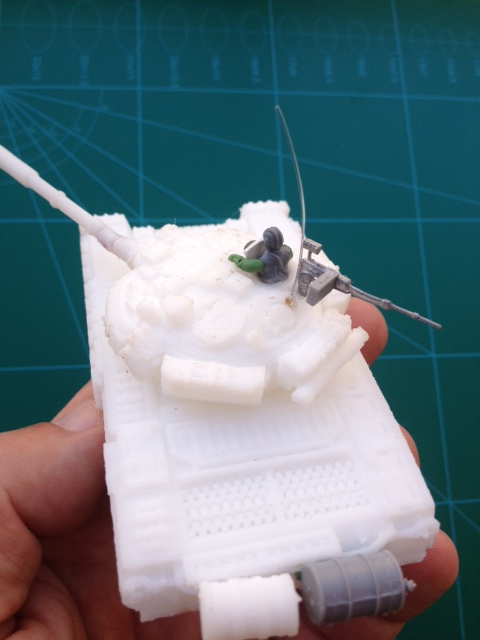
The white plastic doesn't let see the level of detail of these 3D prints but you will see after painting that these are really good.


The usual few extras like antennae, MG and torsos with GreenStuff arms.


The final result is great and with only two parts - turret and hull - you can't have an easier model. 

Tuesday, 20 September 2016

A wargaming trip to Constantinople 1453 - Part four (and last), the Military Museum of Istambul


The Military Museum of Istambul is a classic museum crammed with paintings, weapons and dioramas. In spite of its nationalistic aproach, in which for instance the thugs of the Armenian genocide were the Armenians themselves and the victims were the Turkish soldiers (when its more than proofed it was otherwise), its a nice and big space with plenty to see. Save yourself at least some 5 hours so you can see everything.

Regarding Constantinople 1453 there is plenty of information. The top picture  is a nice diorama of the conquest where you have to the right the Genoese Galata neighbourhood and to the left the main Constantinople itself.


Here you can see the road built by Mehmet II surrounding Galata in order to transport by land the besieging fleet after discovering that the defenders had a big chain protecting the mouth of the Golden Horn.


The remains of the original chain can still be seen in the museum.


Panorama style you can see a very beautiful and detailed painting of the main assault. I took  several sequential pictures L-R so the detail can be seen more clearly.


The painting also shows some scattered materials like artillery baskets, guns and helmets which enhances detail.


Even today you can find remains of the walls of Constantinople everywhere. Even normal houses or shops used them for its own benefit.

Istambul is a great place for holidays speciallly for the History lover and the Constantinople siege of 1453 is a great wargaming subject. I hope to have contributed for that in this series of posts.


Sunday, 18 September 2016

Rapid Fire! Russian Contemporary Wars in 1/72nd - BMP-1's


Last addition to this series are these S-Models BMP-1. The models are superb, containing photo-etched parts sometimes even superfluous. 


As usual the drivers have arms made of GreenStuff. The torsos are PSC. This camouflage is close to the Russian BMP's of the peace keeping force in South Ossetia in 2008.


This camouflage is more usual and matches some of the tank companies I've painted. 


Wednesday, 14 September 2016

Rapid Fire! Blitzkrieg in 20mm - Dutch and Polish aircraft


Some more Blitzkrieg planes. The one on top is the main Dutch fighter, the Fokker DXXI. 

I don't have much more for the Dutch. The ground forces can be seen in this old post: 

http://jpwargamingplace.blogspot.pt/2011/06/dutch-army-1940-20mm-172nd-scale.html


For the Polish I have an army filled with good intentions, with Hat and First to Fight models all waiting patiently on the shelves but with nothing painted or built yet.

The exception are these three planes. On top the famous PZL11 a model by Encore.


Here, the PZL23 Karas (Heller) and the PZL37 Los (Plastik). 

Tuesday, 13 September 2016

A wargaming trip to Constantinople 1453 - Part three, the Panorama


A few hundred meters from Edirne gate, just in front of the last picture in  the post about the Theodosian Walls, you have the Panorama Museum of the Conquest of 1453.

Its a very nice place, quite nationalist as many Turks like. You have in one floor plenty of images and text about 1453 and in the other a very good Panorama, Waterloo style with an accurate 360 degrees painting of the main attack to the Theodosian walls.

I took sequencial pictures (L-R) starting with Mehmet II place (the one in a white horse) with his Householse cavalry and Solak archers nearby. The units are very well placed in the Ottoman line of battle and the flags are particularly good.


The assault of the Ottoman cavalry: Azaps, Bashi-Bazouks and Sipahi...


... and Kapikulu cavalry in more heavy armour.


In this one I like to think the Byzantines are throwing Greek Fire from catapults. The lower part of the walls was the Mesoteichion. 


Janissaries are already breaching the wall in the top of the Mesoteichion area of the Theodosian Walls. 


The Gate of Spring under attack. 


The three lines of walls are clear in these two sections of the Panorama.


The effect of the Turkish heavy artillery is well depicted in this section of the Panorama.


The Constantinople walls were not built to endure artillery. In fact they were mostly built around the XI century when there was no such menace and also when the Byzantine empire was at its peak. Now it had only around 10.000 defenders to prevent its falling.


Orban's artillery was everywhere pounding the old walls. Orban was a Croat who designed most of the Turkish artillery used in the siege.


The balls thrown by the artillery were big stone balls. Some are present as 3d elements in the Panorama as well as some artillery and their size is impressive.


Long lines of Janissaries are preparing for the final charge. In spite of the importance of the event nowadays research places the Ottoman army around 50.000-80.000 and not the hundreds of thousands of XIX century literature.


Monday, 12 September 2016

Rapid Fire! Russian Contemporary Wars in 1/72nd scale - Painted T-80s and T-90s


The group of ModelCollect and Revell modern MBTs I've built some time ago are painted and shelved.
You can see the parent post on its construction here:

http://jpwargamingplace.blogspot.pt/2016/07/contemporary-russian-wars-in-172nd_13.html


Somewhere in the Russian southern border (in fact my yard) a Russian tank force amasses waiting for orders.

The top row are T-80 BV and the nearer are T-90MS, T-90 and T-90A.  Frankly after painting the two brands are indistinguishable with only the weight showing the heavier ModelCollect.


The T-90MS is the state of the art Russian MBT (not counting the still scarce T-14 Armata...). The painting is based on the web where you can see this kind of sand and orange over green camouflage. 

The figures have GreenStuff arms so they can fit wherever I want. 


Here a PSC figure is preparing to fire its HMG with its new arms. 


The Russian flag is in all vehicles. Its an obvious exaggeration but Russian enemies also have the same material many times (Chechens, Georgians, Ucranians...) and the old style flag clears all doubts. 


Another nice feature of nowadays Russian armour is the different camouflages even within the same units.

The paints I refer in the next paragraphs are just the ones I use and not mandatory.

After some reading about Russian camouflages you can settle with this:

As base colours, they have two different shades of green, one lighter olive ( Citadel Loren Forest) and another darker (Vallejo 114 Russian Green, yes, yes, aviation colour).

As camouflage colours you can find two tones of yellow sand ( Vallejo 819 Iraqi Sand and Citadel Tausept Ochre), brown (Citadel Mournfang Brown), black (whatever you have),  grey ( Vallejo Light grey and (more recently) orange (Citadel Macharius Solar Orange).

For better results I advise the excellent Mig paints specially designed for these conflicts.


Friday, 9 September 2016

A wargaming trip to Constantinople 1453 - Part two, the Theodosian walls.


These are pictures of the north west and west walls part of the Theodosian walls, the only ones not protected by water and that took the brunt of the Ottoman attacks.

The total lenght of the Constantinople walls is around 20 km but the Theodosian walls on this post are around 6,5 km. 

 As can be seen most of the structures suffered serious damage. 

Nowadays they are well protected but probably most of the heavy damage must have been made during the siege and the assaults of April and May 1453.


The idea of this picture of a piece of wall  is to copy and duplicate in order to use in the scale model of Constantinople. 


The gate that leads to the grave of  Abdüssadik, one of the religious followers (sahabe) of Mohamed the founder of the Islamic religion, killed during the failed Arab assault of 674.  The grave is behind the fence you can see after passing the gate. 

At this spot also centuries later, the last Byzantine emperor, Constantine XI Palaeologus, was last seen on the night of May 28, 1453...


Towers and structures of the north west wall. 


Gate of Charisius (also Adrianople gate, Edirnekapı in Turkish) from where Mehmet II, the Conqueror, entered the city. 


The inner side of the gate of Charisius.


From this picture (N-S) you can see the length of the Theodosian walls that overlap the line of the horizon.

This area, the Mesoteichion (middle wall) was heavily bombard by the ottomans as it descends to the Lycus stream and the attackers were in front in higher positions.  


Here you can clearly see the second set of lower walls that defended the city, and may be the third set of walls (breastworks). The area between the lower and the main wall was the Peribolos. 


In front of these towers (to the right of the picture) you have the Panorama Museum.


The area in this post is from the bend in the northern tip, in front of Keras,  up to the proximity of the 4th Military gate. 

Next: the Panorama Museum.