Another plastic and resin force amassed through decades representing the Germans present at Poland, France and USSR up to February 1943. The brown camouflaged vehicles of the first few minutes give away to more grey as the video overcomes July 1940. As usual some mistakes are said (once "Barbarossa" is mentioned instead of "Blitzkrieg"). Also the forgotten brand of Renault ADH is ShellHole Scenics.
Friday, 20 October 2023


Saturday, 14 October 2023
Hastings 1066- The Saxon army in 20mm for Impetus rules

The conquest of Saxon England by William, King of Normandy is a fascinating story. I became even more fascinated by it when in ... let me check PSR... ah, yes, in 1989, Revell released its two sets clearly designed for Hastings 1066.

Since then I amassed a good quantity of both boxes - Saxon and Norman - in order to be able to make the Saxon shield wall and the three Norman divisions that charged up Senlac Hill (some say Caldbec Hill, in a more recent theory). Recently I based all the figures in Impetus Rules bases, ideal both for massed heavy horse and shield walls and painted a few more.

Both boxes have good figures for the Housecarls armed with two handed axes of which three were made. Some of the figures had small pieces of plastic added in order to extend the lenght of the Dane axe and plastic shields.

Also using chain mail, the Thegn figures used had plastic shields added some round and others with tear drop shape. Some of the Thegn figures on the back row (standing with spear) are the Saxon horsemen cut in half and glued to Esci Roman legs.

King Harald Godwinson was made from the Revell Russian Knight commander with converted card and broom stick banner. This picture was obviously taken before the arrow that pierced his eye and brain. The colors came from a British reenactor photo found on the web.

The Saxon Fyrd was also made from both boxes but with many more from the Saxon box. A total of five stands of Fyrd were made but I hope to make at least as many in the future as the Fyrd was more than the double of both Housecarls and Thegns. Also two bases of Lithsmen are on the cue. The arms were bent by fire in order to produce figures with the shield protecting the body and the next comrade, thus creating a shieldwall. Also many of the swords were replaced by spears as these were much more common and less expensive.

One of the two Thegn stands had a few Revell Russian knights mixed with Saxon and Norman figures. The Russian knights are also good for many XI/XII century conflicts throughout Europe and mix well with Crusaders, for instance.

Not much is known about Saxon archers, slingsmen or javelinmen at Hastings but there were some for sure as there is even a theory that its a Saxon arrow that kills King Harald. I made three stands of them also using the helmetless Norman swordsman ( a relatively useless figure, good for Robin Hood movie scenes) to produce a few javelinmen. Their sword was cut and a small needle and shield were placed instead.

This one is just for you to see that the arms can easily be changed with the help of a hot iron for the making of the shield wall.

In this selection of figures from the PSR site you can see that the 1st and 2nd figure to the left can have its left arm heated in order to protect the body and create the shield wall and the 3rd and 4th figures can have easily added shields on the Thegn stands.
Next: The Norman army for Hastings but more probably a video on the German WW2 "Panzer Grey" period as the whole Norman army still has to be built.
Friday, 6 October 2023
"New Kingdom" Egyptian army in 20mm for Impetus rules

The nostalgia wave continues with the revamping of old and some new builds for this Atlantic force. Atlantic was an amazing Italian brand from the 70´s. Most of its HO stuff was around 1/87th scale like the 20th century figures and Far-West, with vehicles and landing craft sitting somewhere from 1/144 to 1/60! In this childhood days whatever fish that came to the net was eagerly played with and I spent hours around all their stuff. But a different story has to be told about their ancient range - Egyptian, Trojans, Greeks and Romans - were beautiful 1/72nd scale models even if with poetic and Hollywoodized details.
The brand then decided to move to Lebanon and was caught in the middle of the Israeli invasion of 1982 and many of its moulds were never seen again. Nexus came after and continued for a few years with the survivors but somehow Atlantic - like Atlantida - was lost forever.
 |
I used three boxes of infantry for this host. The Atlantic boxes were not only cheap and made of excellent plastic (no broken figures after 40 years) but also had more than 60 figures inside. This Egyptian set is great for Old and Middle Kingdom as no figure has armour with nice shields and a correct choice of weapons. The only problem here is the small number of archers (one pose only) which should be half of the total infantry. The standards were made from GreenStuff modelled into broom sticks and glued to the a relatively immovable pose. I left the figures with the Pharaoh´s Deshret crown like that and they became officers which is not correct but looks good. In the old Egyptian armies the officers fought from the back of the phalanx and I did the same here.

The archers came from the infantry box and the three poses of archers from the chariot box. Some of the figures are the Pharaoh from the chariot but his head was modelled in order to have only hair without the Pschent Pharaonic headdress. You can´t get many archers unfortunately from Atlantic and other brands will have to come to rescue in the future like Zvezda and Caesar.

The only reason I can call it a "New Kingdom" army is because of the chariots. These were introduced by the Hyksos and thus this new weapon can only be used by New Kingdom Egyptians. The chariots were usually accompanied by skirmishers as you can see here - probably very fast runners!! So here Atlantic mixed different periods of Egypt history but I have some plans to upgrade the last few boxes of Atlantic Egyptian (old/middle) infantry ...


Kept for some 40 years in my basement was the Egyptian boats box. Up until last week I was convinced that this box had standard bearers and rowers inside due to the beautiful box artwork but in fact the standard bearers are the one from the Pharaohs´ court box and rowers are conversions from infantry positions.

The rowers are conversions from the figure holding the small Khopesh. Arms were bent to position and a piece of plastic sprue gave the rows.

This kind of cover, even if with some rather strange boats, was making us dream when we were kids and I think they contributed for my love for history. And her you have the "fake" rowers and standard beares (left boat) not present on the box.

This Sphinx was also waiting painting and basing for a few decades and finally it was done. Its funny how Atlantic portrayed the Sphinx in stone color while it was found more recently that it was painted as it had some vestiges of a reddish paint in the back of the ears.

This was the full series of Atlantic Egyptians of which you can see four in this post (infantry, chariots, boats and the Sphinx). I still don´t have the court, the Pharaohs' boat and the temple and I hope to find them one day at reasonable prices mainly for the sake of nostalgia. Well, while there is life there is hope!
Next: Impetus rebased Saxons.
Sunday, 1 October 2023
Able Archer/ RFR rules (?) - Russian invasion of Ukraine 2022 in 20mm (part 13) - Ukrainian Leopard 1A5 and AS-90 SPG

These three are the latest addition to the Ukrainian forces. The AS-90 is a 4D model with new wheels as explained later. According to the famous leaked papers by a Portuguese descendent (it had to be...) it can be found at least in three of the mechanized brigades in the nowadays counteroffensive, the 21st, 116th and 117th MBs. The old Leopards 1A5 (Esci models) arrived in sufficient numbers to equip three Ukrainian mechanized brigades but it will be hell for them to keep up with the amount of technology and hardware in the actual battlefield a bit as the old Russian T-62. For me the arrival of old material (and lack of ammunition) at the front is the proof that both sides - Russia and NATO- were not expecting this war to go as far and no one really was expecting to escalate as it did. And this applies to the provokers of this conflict that exist on both sides.

These are the wheels that came along the majority of the 4D first series of tanks (both 1/87th or 1/72nd). Obviously they had to be replaced.

With a decent hull and turret and the addition of some T-72 wheels from ModelCollect leftovers the 4D AS-90 becomes pretty decent.

The usual journalist's view of the Ukrainian SPGs.

The Esci Leopard 1A5 were in the stash for an entry into the Turkish army of the 90s and for an eventual conflict with the Iraqis, but obviously ended up in Ukraine. In the Ukrainian service some pictures emerged with them covered in camouflage netting (here made of gauze dipped in white glue and modelled directly on the tank). The only addition in relation to the Esci model is the turret range finder, tank commander and antenna. Fortunately the gauze also covers other missing parts in the Esci model that the real tank has like hull side boxes and other small details.

The end result is ok. I still have the Altaya Leopard 1A2 in the stash and I´m thinking of converting it to the A5 version thanks to Saint Gauze as it will hide most of the differences.

Next: Atlantic New Kingdom Egyptians for Impetus.
Sunday, 24 September 2023
Able Archer/ RFR rules (?) - Russian invasion of Ukraine 2022 in 20mm (part 12) - The best heavy metal from both sides arrives

In the last few months the best armored machines from both sides - Russia and Ukraine/NATO- started to show on the battlefield: the Russians introduced the T-90M in increasing numbers, as they have the industrial capability to do so, and the Ukrainians received from Germany and Portugal 21 Leopard 2A6 taken from the stocks of each armed forces. Excluded here are the Leopard 2A4 and the Swedish Strv122.

The T-90M is the state of the art of the Russian tanks (not counting the T-14 Armata, very expensive and with problem in ist production). Its based on the T-90 series, derivative of the T-72 series, but solving an old issue with the automatic loader for its 125mm rounds by displacing the ammo store and carousel to the back as many of the western designs did, and introducing newer armour and engine, a remote-controlled HMG and other details like a new telescopic mast and so on.
The models are Modelcollect (left) and 4D quick builds (the two to the right). Years ago the way to have contemporary Russian vehicles in 1/72nd scale was to buy Modelcollect which at 25 euros each was a good way to go bankrupt, specially when you want always big units. The 4D models, ordered through Aliexpress cost around 3 (!) euros each and don't owe much to the Modelcollect as a finished product. If you take pleasure of the model building, then you are at ease with the Modelcollect series, filled with parts that fit marvelously, but, if you want a quick (and cheap) build still with detail then you go 4D, which has nowadays the same quality as PSC, Armourfast and alike.
When first showed up, 4D was intended for kids to play with some 20 or so models from WW2 and modern periods, all with the same ugly wheels in both 1/87ish and 1/72 scale. I bought a big pack with all of them but could only use some 3-4 and these only after placing new wheels and tracks. Well, for around 1 euro each it was not a problem and in fact I'm around a AS-90 SPG from 4D which turned out nicely - after new wheels and tracks, of course!

The German Leopard 2A6 is considered one of the best tanks in the world surpassing all opposition - east and west - in many events and military shows. Even so, some 16 (Oryx) to 31 (Weeb Union) Leopards 2, all variants combined were already put out of action. This variant was apparently concentrated on the 47th Mechanized Brigade.
The models are Altaya die-casts of the Leopard 2A5, with the shorter gun. In order to make the gun larger, up to the A6 variant size, an extra piece of EverGreen styrene was added and everything was disguised with GreenStuff in the form of camouflage netting. I did the same to my Portuguese Leopard 2A6´s of the Brigada Mecanizada and to my nowadays Germans. The camouflage was left as it was and the only additions were the stencilled crosses and the usual antenna and stowage.

Finally some Marders for the 82nd Airborne Brigade joined the group. In fact only the one to the left is the correct variant for Ukraine, the Marder 1A3. Both models are die-casts. The colour applied on the Marder fleet by the Germans recently seems to be a plain medium green and not this NATO camouflage, but this older scheme was also spotted in Ukraine in some units.
Next: More Russo-Ukraine war.
Saturday, 16 September 2023
Impetus Rules - Mohacs 1526, part 8 - Hungarian Clipeati and Armati in 20mm

Extra Impetus Nº3 mentions 4 heavy infantry stands each of Clipeati and Armati for a sizeable Hungarian army of the Mohacs period. The problem here is that generally the Clipeati formed the shield wall from were the Armati, probably armed with pole weapons, would fight in a somewhat tight phalanx. The extra Impetus separates both types of heavy infantry but I prefer to use them together in the same stand. In the future, if I see my life in danger in a game or so, I can always divide the stands differently between Clipeati and Armati.

The Clipeati and Armati figures really look nice together and you can deepen the Impetus spirit of nice big stands that look like dioramas.

The figures used are some very nice Caesar copies ordered from China through Aliexpress. For just some 3 euros you get 200 1/72 figures in a poly bag which is obviously a great value for what you pay. The plastic is harder than poly figures and holds the paint very well. The figures were copied from some of the figures of the two boxes of Caesar XIII and XV century Medieval European Knights. I only used here the ones from the XV century as they are closer to the Hungarian heavy infantry of 1526, even if not a match as there were also some different helmets and pieces of equipment on those day´s Hungarian army. As pole weapons are necessary for the Armati many of the figures were converted as pikemen. In the above picture you can see the original figure (armed with sword or an halberd) sided with the converted one armed with a pike plastic made of a broom stick. Many of the halberdiers were left with its weapon as its a very probable weapon of the Armati.

I left all Clipeati armed with swords just because they look as if they are somehow dealing with the shield. The shields were made of slightly curved plastic from 1Kg yogurt buckets. This is an highly simplified form of the shield as generally the heavy infantry Hungarian shield had a vertical boss all along. They were colored with photocopies (the ones red chequered or with the Hungarian coat of arms) or hand painted like the tri colored ones.

The back of the shields were painted brown and were kept standing just with one piece of plastic. Not sure if one or two legs hold these pavesi type of shields but like this it became simpler.
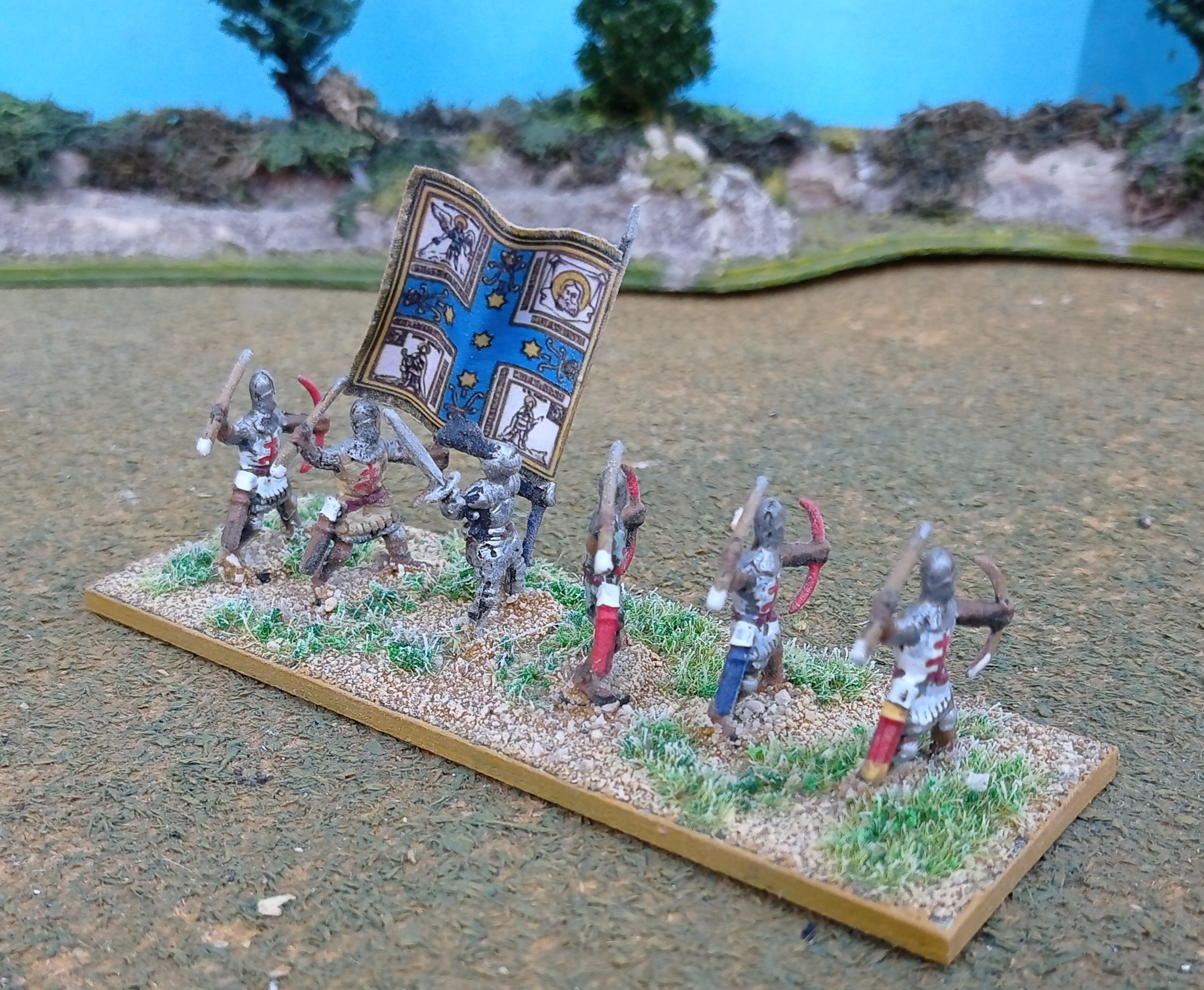
Another 4 stands of archers were also made in order to finish the 8 that are mentioned in the lists. The flag of this one came from the Russian XIX century Opolchenie. Not the happiest union as there aren't many orthodox people in Hungary.
Next: Maybe a return to the nowadays Russo-Ukrainian war.
Wednesday, 6 September 2023
Aztec army in 20mm for Impetus rules

In 1991 Revell released the Aztec box. It was the days in which the hobby was starting to go away from WW2 and Napoleonics and diving into different periods. Revell gave a big push in this direction. The main historical opponent of the Aztecs and the Triple Alliance were other Mesoamerican cultures (the Spanish arrived only in 1519) like the Mixtec and Zapotec more to the south of nowadays Mexico and bordering Guatemala. With this in mind I gathered 10 boxes of Revell Aztecs not only to make an Aztec army but also to have enough figures for a Tlaxcala army for instance. Reading about Aztec warfare is also a fascinating issue with elaborate marching procedures, tactics and different colors and equipment (uniforms if you wish) according to each of the seven types of infantry and even different colors for smaller groups of around 400 men. In this picture you can see more or less the equivalent of a xiquipilli (regiment or division) of 8000 men taken from the calpulli (original clan areas). Impetus rules doesn't care about this but if you want to wargame with specific orders of battles (not easy though...) up to the battle of Otumba or the final fall of Tenochtitlan, each base can represent 400 men (one xiquipilli total) or 800 men (two xiquipilli). Most of this large group was painted for decades by now but recently I rebased them according to the Impetus stands.

Starting with the lower infantry you can see five bases of novice soldiers who still did not captured any prisoner (for sacrifice, obviously). They are armed with spears or the famous maquahuitl, both with obsidian blades. Mixed with the Revell there are also some 30 Atlantic Egyptian conversions. The only few changes on the Atlantic figures was the addition of a misang on the top of the head in order to represent the head knot and the replacement of the Egyptian shield with a round one. The maztatl (crotch loin cloth) was simply painted upon.

These skirmishing archers and slingers are mostly Revell but each base includes a Mixtec influenced atatl made from an Atlantic conversion. For the atatl you just need to glue a spear on top of the hand weapon and it will look the part, at least on this scale and bend the arm for a more throwing attitude. The closest archer on the right side is also an Atlantic conversion.

Regarding archers most of the stands have pairs of an archer and a shield bearer in typical Tlaxcallan style but most probably also used by Aztecs. Once again there is a mixture of Revell and Atlantic conversions.

This group can be a number of different types of infantry from the papalotl (three captives) up to the cuachicqueh (seven captives). Frankly all these types are not very well represented in the Revell box which prefered more generic poses missing specific headdress and back banners. One day I may take a number of mohac style heads of the WW2 US paratroopers from both Esci and Revell in order to make proper cuachiqueh.

Now into the military orders. The famous Eagle warriors have three different figures and that includes a commander with the back banner. This kind of brownish color seems to have been used but recent investigations gives a wider variety of colors to be used.

Another military order was the Jaguar. Nowadays I see them in blue in many representations but years ago I saw them somewhere in jaguar colors. Again three positions in the Revell box that, if placed carefully can give animated stands.

These warrior priests were the only group made recently and are all conversions using Revell figures with the conical hat on top.

The Osprey image that inspired this last group.


As I painted four boxes of Revell Aztecs it gave twelve commanders that were simply painted with no conversions. The only stand that had an extra was the commander of the army, a tecuhtli, that received the company of this crazy naked berserker dying to capture prisoners for sacrifices, or being killed in the process due to the absence of the heavy cotton quilted vest. The figure is another Atlantic converted figure.
Next: more Impetus stands but with a return to Mohacs 1526.
Sunday, 27 August 2023
Borodino 1812 (part 8): Markov´s Moscow Opolchenie for AOE in 20mm

The Opolchenie was raised during the Napoleonic wars and consisted of militia taken from servitude under control of line officers. Naturally they were ill equipped both in uniforms and weapons, but usually having a long grey coat (or in several shades of brown), some would have a musket and many other would have several types of pikes, including one with the shape of a musket but really nothing more than a pike. In fact they should be arranged in their Druzhin (regiment) per type of weapon but I placed muskets in the first two ranks and pikes in the third. The headgear should be mostly fur hats for these ones recruited in the Moskow region but as the Opolchenie were quite irregular in uniform I also bunched them all together.

The figures came from six Hat sprues of Opolchenie I found in Aliexpress as I couldn´t get the original boxes anywhere in UE area. Also in this lot were used some 10 Landwehr from a sole Italeri Prussian box I had around. They fit well with the Hat figures as they are similar in size. In fact the Russian Opolchenie influenced heavily the Prussian Landwehr uniforms (in fact if you have the old Airfix Landwehr, don´t bother and use them as Saint Petersburg Opolchenie). The same thing happened with all the Prussian army from 1812 to 1815 which had in the Tzar uniforms their main influence.

The figure firing in the photo is an Italeri Line Prussian. Has it had a coat its shako was placed on fire and squashed until it got the form of a cap.

Two of the Druzhin got red markings and one got blue. Finding information on the Opolchenie is not very easy - probably you can find plenty in Russian - and the best reference in English looks to be "The Brazen cross of courage" by Stephen Summerfield which unfortunately I don't have. There are some great reenactment Russian groups you can find on the web which will provide some very nice inspiration.
 The few conversions made were on the figure yielding an axe, something that doesn't go very well with the rest of the figures which are in calmer positions. One of them became an horse holder for Count Markov and five other became standard bearers.
Probably this 8th post on the Russian army at Borodino will be the last for some time in this series as I've covered all types of 1812 Russian soldiers, less the Dragoons that I couldn´t find.
Next: rebasing Aztecs for Impetus.
Subscribe to:
Posts (Atom)