Tuesday, 5 August 2025

A wargaming trip to Bodrum castle


Slowly by slowly I´m on the track of the Knights of Saint John castles, after almost 30 years ago of visiting  Malta. Now I had to opportunity of visiting Bodrum castle in southern Turkey. 

Some information on the military activity of the site: 

During the years of 1402 up to 1452, the Knights Hospitaller built in two phases the Bodrum Castle. In fact the task belonged to the Knights of St. John who built it in order to guard that tip of Mediterranean and its northern access  from Turkish expansion, as the castle faced early threats from the Seljuk Turks. 

Between 1453 and 1480, Sultan Mehmed the Conqueror launched naval attacks and bombarded the castle. In 1480 his fleet caused damage to the English Tower and seafront walls, but the fortress held strong and was later reinforced using stone from the Mausoleum of Halicarnassus. 

As Suleiman the Magnificent’s forces conquered Rhodes, the Knights surrendered Bodrum Castle in 1522 as part of the peace terms and its fortification process continued. 

In 1773 during the Russo‑Turkish War (1768–1774), a Russian naval detachment under Admiral Elmanov bombarded the castle and landed troops (~1,000+), but the local Ottoman garrison repelled them.

The castle was heavily garrisoned  and later was used as a prison (from 1895), with the chapel converted into a mosque and a minaret added.

In May 1915, the French warship Duplex bombed Bodrum Castle, causing significant damage, forcing the evacuation of prisoners, and damaging the minaret and southern ramparts. 

 From 1915, Italian forces briefly controlled Bodrum and used the castle as headquarters before yielding it back to Turkish control in 1921 (via agreement after the War of Independence).


Exhibition Areas

1. Haluk Elbe Art Gallery

2. Cannon Exhibition Area

3. Gateway Tower

4. Amphora Depot Exhibition Area

5. Southern Observation Terrace

6. Turkish Bath

7. Chapel (Castle Mosque)

8. Anchor Exhibition Area

9. Stone Artifacts Exhibition Area

10. History of Underwater Archaeology

10. Amphora Exhibition

10. Serce Limani Glass Shipwreck Exhibition

11. Yassiada Shipwrecks Hall

12. Spanish Tower: Tektas Shipwreck Exhibition

13. German Tower: Bozukkale Archaic Shipwreck Exhibition

14. History of Bodrum Peninsula and Halicarnassus

15. Italian Tower: Early Bronze Age Necropolises Exhibition

16. French Tower: Musgebi Necropolis

16. French Tower: Pedesa Ancient City Exhibition

17. Halicarnassus Eastern Necropolis Exhibition

18. Carian Princess Hall

19. Late Bronze Age Shipwrecks Exhibition

20. English Tower: Knights of Saint Jean Exhibition


The castle stood initially in a small island that had to be connected to the main land making it into an artificial peninsula. 


The 1st phase of the Knights of Saint John build created most of the visible structures that can be seen today. 


Best explained here, as the previous text can only be understood by the large numbers of my Turkish followers (which in fact speak a language that is not easy for most of the european language speakers). 


The 2nd phase of construction by Knights of Saint John saw a secondary line of walls and two more more small towers (Carretto and Gatineau). 


As usual with Ottomans a minaret and Turkish bath was added. 


And this is virtually the looks of the castle today, an impeccable work of art and a place of respect for History as the Turks are very good at preserving their history, even if part of it comes from Greek, Roman or Christian origin. 


A bit of text for the later events. 

 
A minaret of the Ottoman period was destroyed by a French ship during the preparation of the Gallipoli campaign and later rebuilt to the actual state. 


The most important parts of the castle - excluding its walls, obviously! - are the towers, each of the Langues of Knights contributed with one. So each of the main nations has its own tower: there is a  Spanish, an Italian, a French, an English and a German tower. The one above is the Spanish tower.


Another view of the Spanish tower.


The steps leading to the Italian and French towers.


The French tower.


Another view of the French tower. Its topped over the harbor and exhibits the Müsgebi Necropolis and the ancient city of Pedasa.


The Italian tower, the tallest of them all, hosts the Early Bronze‑Age Necropolis hall and the Carian Princess burial displays


The English tower has some nice heraldry and foot soldiers equipment. 


There is a moat between the two layers of walls. 


Here you can see the two layers distinctively. 


The English tower with its Knights armor and equipment. 


As you're exiting, you may be passing through the main gate complex, and you’ll likely see the insignia of the Grand Master Philibert de Naillac (served 1396–1421), who initiated the construction of Bodrum Castle in 1402, together with the insignia of the Knights of Saint John. 

Next: Guadalcanal, part 1.

Sunday, 3 August 2025

Able Archer/ RFR rules - Vietnam in 20mm (part 13) - Reinforcements for the 11th ACR and some more aircraft


Some 11th Armored Cavalry Regiment (ACR) elements advance in the middle of My Blue province when they are surprised by a low flight of some friendly aircraft, that could well have been some Migs... Well, this event was not registred in the unit´s history and its presented here first hand. 


Each squadron of the 11th ACR had three rifle squads (one per troop) transported in M-113 A1. I read that even these ones could also have the ACAV version but the regiment will end up with nine of these so three of the more plain A1 version looks OK. I´m not sure about placing a simple shield in front of the 12,5mm gun but I still couldn´t find a photo of them like this, the ACAV version being the more common. All models are quick build S-Model.

The figures are left-to-right, Skytrex and Airfix modern fighter pilots which suit the US cavalry tank helmet pretty well. 


Each troop also had a M-106 mortar carrier. I used again the S-Model for this conversion using a M-106 from Esci as a template. Bits of different types of plastic were used and even the mortar base came from a Revell 7YW Austrian artillery wheel. 


The crew is Esci and the M-16 rifles were cut until looking like a 107mm mortar shell. Later, the rifle part/shells were smoothed with a bit of  thick acrylic paint. 


As the mortar base was very brittle (old Revell style) I placed a jerrycan covering the damaged part. 


The floor of the M-106 (light sand part) was also raised so the figures and mortar could sit correctly. 


The Cadillac V-100, mostly used by the Military Police, are very old Corgi Juniors toys. The size is around 20mm as I have a number of Saudi V-150 in 1/87th scale that are smaller. 


The resin figures are surplus from the 3d printed PBR boat and the metal figure is Skytrex. 


The Huey Gunship is Revell. 


The Mohawk is the old Hasegawa model. One of these slow moving aircraft managed to put down a Mig-17 with its rockets, something that was kept as a secret up to 2007, as the army didn´t want USAF to know about this feat and force the Army to disarm its Mohawk as putting down Migs was a USAF exclusive. 


This A-4 Skyhawk F is the old Frog in Israeli colors. All these three aircraft got new star and stripes decals from the decals left-over box and all other symbols were hand painted. This one looks particularly bad as the symbold are painted on top of the grey primer as its (just by chance) the same color and painting style of another Skyhawk C from Altaya that I showed you before. 

Next: Guadalcanal models or a video on Bodrum, Gettysburg or Tarawa. 

Sunday, 27 July 2025

Able Archer/ RFR rules - Vietnam in 20mm (part 12) - Armored vehicles for both sides


In this FOW style picture, were tanks point at point blank range to each other as if coming from holes on the ground, you have the two missing Sheridans, 2/3 of the necessary M113 ACAVs (both types of models for the 11th ACR), a M42 Duster, just because it was on the stash, and the first few T-34 and T-54 for the NVA. 


The ACAVs are Eskice, printed in Germany by Tom Hobby. I continue to be amazed by these resin 3d printed models as this, for instance, has two pieces, one being the 12,7mm HMG turret, with gun and figure, and the other, well, all the rest, including figures...
I already had some Eskice in the form of six German WW2 side-cars and enjoyed painting them a lot even if they have big heads which doesn´t make them good neighbors for most other brands, exceptuating the sort of the old Britannia metal figures. 


With three more, the full ACAV numbers will be achieved for the 11th ACR. 


Only a few jerrycans, antennas and some stowage was added. 


I made a small raid into the box were I have the 1st group of 4D models. They are around 30 (some 1/72ish, others 1/87th scale) and, if I can remember well I could only use some 4-5 of them (heavily converted, though) as they are toys and not real models, with the bottom part, including wheels, being all the same throughout the collection. The M42 Duster is no exception. But by looking at a comparison on the web between the Altaya and the 4D M42 Duster, I realised the top part of the 4D model is quite reasonable. 


What the 4D model mostly needs is some new wheels that came from derelict Hasegawa M24 Chaffees, glued against a piece of thin cardboard as they needed to be a bit far from the bottom part, which is the same on all 1st series 4D models. Then some crew, stowage, antennas and a HMG were added. 


The Atlantic crew figures lost their heads  as they were too small and were replaced by Hasegawa pilot´s. 


The Sheridan to the left is Airfix and the other is Altaya. They got the same treatment as the first I made a few weeks ago. Now there is one per squadron for the 11th ACR, which is the intended number. 


For painting all these vehicles I followed my first Altaya Vietnam models procedure: the Altaya Vietnam models (Gun Truck, M41 Bulldog and M48A3) came painted in olive brown with the usual sheen of Altaya vehicles; in order to break that sheen I slightly sprayed Krylon's Panama Khaki, which is something I continue to do with all models from other brands for this theater (the olive brown used is Vallejo). In period pictures, Vietnam models are many times covered in mud due to the rainy seasons. This in fact saves two moments of painting, the black wash (which needs a few hours here - days, in England, he,he) and the main color + white drybrushing. 

Finally a few NVA tanks. The T-54 are 4D models and are a big improvement from the first batch they made, from were the M42 Duster comes. I already made a few of these T-54 for the Angolans and knew how good and easy to build these models are. The T-34 is Polistil, and together with the Airfix Sheridan belong to a small batch of models found in the last month´s flea market at Tomar. Next week I plan to be there again for some extra old findings.

Next: wether Vietnam or WW2 aircraft. Guadalcanal is also close. 

Thursday, 24 July 2025

Able Archer / RFR rules - Last haul from a 2nd hand fair


One of my biggest pleasures, exceptuating the ones were small people are made (or not), is to find old kits that remind me of my childhood. And I think this craze is increasing with the end of the  old style  model shops. So last month I had  news from one of my down town informers (can´t say his name), the one that sells my mother Corin Tellado books, that in Tomar, a city some 70 km from Coimbra (as a side note, Coimbra is still the capital of Portugal, as there is no document of any transfer of capital to Lisbon) a guy nicknamed Zé Manco (Joseph Lame, in english) was selling a large quantity of old plastic models at the 2nd hand fair of Tomar, on the first sunday of each month. So there I was looking for the guy on that day. Not easy as the fair is huge, but I saw a lame guy moving with some difficulty and I was sure to have found my target. 

Among plenty of others, I found these 5 old treasures in perfect conditions:

- The Lancaster will go along with the Revell one I showed a month or so ago just because two is much better than one
- The Sheridan will go to my 11th Black Horse Regiment in Vietnam
- The T-34/85 (had no idea that Polistil made 1/72nd models) with go to the NVA
- The Skyhawk will go also to the Vietnam
- The Seagull will go Guadalcanal as this campaign is starting to bite my brain.

Next month I´ll be there again at Tomar as Zé Manco still has a big box at home that he didn´t bring last time. 

Next: More Vietnam, mostly vehicles

Tuesday, 8 July 2025

Able Archer/ RFR rules - Vietnam in 20mm (part 11) - The Mobile Riverine Force


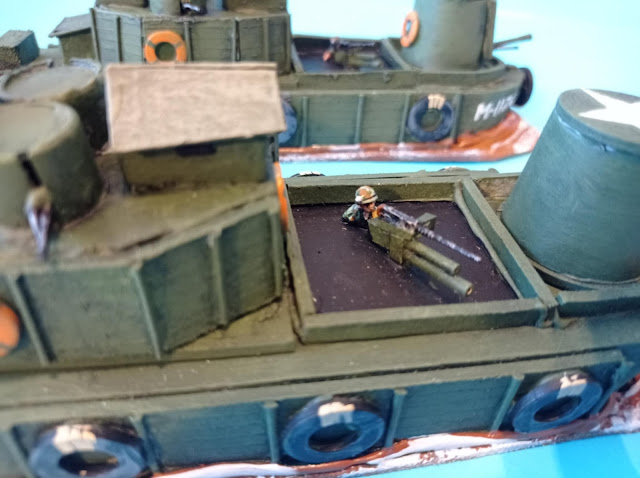
The Mobile Riverine Force (MRF) was created in 1967 to counter the VC activities in the Mekong river. These  boats were conversions from the LCM 6 and carried plenty of fire power and had bar armor to protect from the RPGs. The main boat type was the Armored Troop Carrier (ATC).


The MRF was divided into Assault Groups each with around 100 boats of different types capable of transporting one reinforced infantry battalion from the 9th infantry division. The headquarters of these groups was also on water and on board of large LSTs. 


One of the main types was the ATC H (for Helicopter) designed mainly for Medevac. 


Another famous type was the Monitor that would generally lead the column along the rivers. They were heavily armed with 40mm canons, Mk2 mortars and 50 caliber machine guns. Some had M10-8 flamethrowers "Zippo" later on. 


An usual finding in the Mekong was oil, the main reason why the USA... travelled so much around the world. Here this soldier carried as much oil as he could almost drowning on it. 

Of course this story is BS as the black pool is just a way to give some depth to the weapons bay were the Mk2 mortar sits.


Here is another one. The figures are torsos from Esci and the mortars are scratch built. 


The last type of boat is the ATC, the most numerous of all. It could carry up to 40 soldiers and was armed with 20mm canons and 50 caliber machine guns. 


If you don´t want to loose patience doing these things you can have some nice 3d prints already available. The problem for me was that most were from the UK or the US (time + customs problems) or were files from continental Europe and I still don´t have a printer. 

But if you want to loose patience, this is how I did it. The hull was made from wood and its 21cm long (1,5 cm longer than my LCM 3 which was 1,8 meters shorter than the LCM 6).


The control towers were made in hard styrofoam (BlueBoard) and the gun towers are cut down hard rubber chair protections bought in Chinese shops.


Plenty of 3mm card was added for the bar armor, deck and machine covers and ramps. The most troublesome part was to carve horizontally dozens of lines with the X-acto on the side pieces of card in order to simulate the bar protections. The vertical bars are pieces of broom sticks. The life buoys are vinyl pieces. If you want to use Blueboard on your constructions don´t forget to varnish it with PVA glue or acrylic varnish before using your spray primer. 

Next:  more armor for Vietnam

Friday, 4 July 2025

Able Archer/ RFR rules - Vietnam in 20mm (part 10) - First battalions of Vietcong Local Force


The Vietcong was organized in two main forces for the wargames table, the Main force, generally the best equipped and that you can see in a previous post, and the Local Force, not as well equipped as it was made of local inhabitants that had to conceal their weapons all the time and dressed mostly in civilian clothes. I made the battalions of VC Local force with six figures per company and only with one mortar per battalion. The figures Orion and Esci (the guys in shorts and the ones with a soft hat with a peak and AK47). 


The left stand had a moon shaped piece of wood glued to the main round base in order to make the prone figure sit more comfortably. The figure with the AK47 and soft "Khmer Rouge" hat was transformed into the woven straw conical hat with the help of Milliput.


The mortars were scratchbuilt as I have very few left. The figures holding cargo in the Local Force Orion box were converted into mortar crews. 

Next: More Vietnam, probably Tango boats or M-113s. 

Wednesday, 2 July 2025

Able Archer/ RFR rules - Vietnam in 20mm (part 9) - A PBR and a few more US tanks


Just a short one for some new goodies. The PBR is a 3d resin print from Frontline Collection Store that you can get from Aliexpress, the M48A3 is MiniGeneral 3d PLA print and the Sheridan is Airfix. 


The PBR boat (of Apocalipse Now fame) is a beautiful, extremely detailed and well packed 3d resin printed model. Some parts are a bit fragile but a strong base around it solve most of those problems. A number of surplus guns and crew were left aside as they will be helpful somewhere else. 

Its not a cheap thing at around 30 euros but surely its a quality model.


The Sheridan tank got the 11th ACR markings as its the US unit I´m trying to make, it has virtually everything you need for ground US forces: the infantry; the M113 ACAV and other variants; the M48A3, the Sheridan and the M109 together with Huey support. 

The Airfix Sheridan is quite basic but with a number of additions it becomes a reasonable model. Years ago I converted a number of them for Kuweit 1991 with 82nd Airborne colors. The wire mesh at the front are 3d resin printed leftovers. 

This M48 is in fact the A2 variant with a lower engine. In order for it to look taller I used plenty of stowage on the engine deck. Apart from this an Airfix M2 Browning was drilled in the top cuppola of the turret. The 1st tank company of three M48s is done. 

Next: The Vietcong Local Force battalions