Tuesday, 8 March 2016

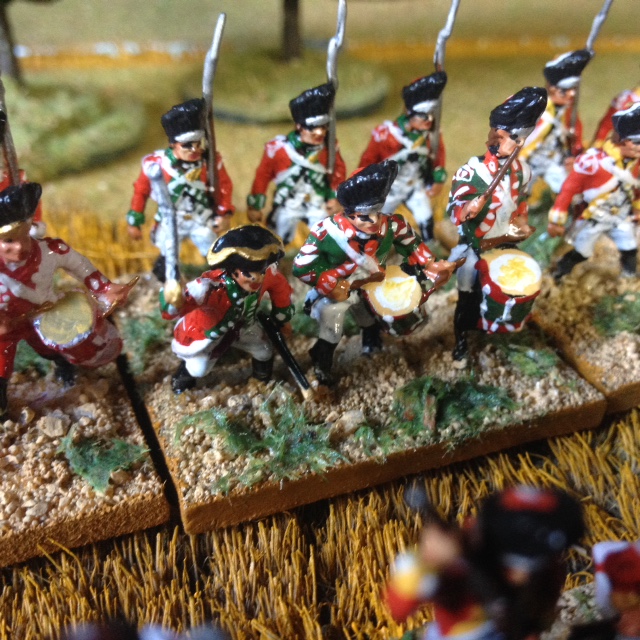
American War of Independence - Will McNally's rules - British 33rd infantry line regiment and some commanders.


This regiment is made almost entirely from figures out of the Revell 7WY Austrian infantry box. The poses are quite "regular" and I think they suit the British nicely. The figure biting the cartridge is one of the best ever! The cuffs are a bit too large for 1777 British infantry but the figures represent well most of the armies of the period.


The pioneer on the second row has its mitre cap enlarged with GreenStuff and the drummer is from G.Washington Airfix box with a grenadier head. The officer  is from the  Revell 7YW artillery box. There is also one Airfix kneeling firer per stand.


The officers are again a mix pot you can probably recognize from Airfix, Revell and Imex. The British officer from Airfix has a body from the infantry box and a grenadier head. The bigger base represent G. Washington itself while all others are Brigade commanders.


The Divisional commanders will have an officer on horse and another on foot.


Thursday, 3 March 2016

American War of Independence - Will McNally's rules - Brandywine historical houses


Now for some freshly painted Brandywine houses. The Gettysburg houses still on the wargame table can finally be replaced. From left to right. Chad's House (opposing Knyphausen division), Birmingham Meeting house (place for the local Quaker meetings and of the most furious fighting of the day) and Benjamin Ring's House (Washington HQ).


I also painted the Hessian Jägers just to keep pace with the many units yet to be built. These are Revell Prussian and Austrian SYW with muskets shortened to look like rifles and the cartridge pouch moved from the back to the waist.


Benjamin Ring's house from the back with a view to the well.


The way my houses are built: just card, wood from icecream sticks and Styrofoam. Some basic calculations and good and plenty Internet pictures makes the rest.


Saturday, 27 February 2016

American War of Independence - Will McNally's rules - Guards Brigade atBrandywine


Last units to be made are the two units of Guards present in the big flanking monouever made by Cornwallys's division.


Only one in each six is really a plastic Revell miniatures the other five are resin copies made in silicone masters. Of course this is a secret information which is better not to reach internet!

This kind of standing position is the best to duplicate and in fact the only one my short-run home-made technology managed to produce.


The command stands are a bit more lively. This officer comes from the Austrian SYW Revell box and a different paint job makes it look like a British officer.


In the other command stand the drummer is that Revell figure in a relaxed pose holding the rifle on the ground. An arm bent, a new head from Airfix and a  plastic cylinder of unknown origin makes the rest. The NCO is another Austrian Revell  figure.

Monday, 22 February 2016

American War of Independence - Will McNally's rules - Brandywine Wargame table so far.


This is my Brandywine table up to now. The table is made of twelve 60cm X 60cm squares for a table of 180cm X 240cm total.

Most of the historical houses will have to be made from scratch as they are represented here by Gettysburg ones.

Still lots of units to be done. I only managed to make some 15 regiments both British and American from the 70 + present on the day.


The battlefield seen from the west (Knyphausen approach side). The area closer to the camera (phone in fact, but 'camera' sounds more professional!) shows Brinton's ford to the left and Chad`s ford to the right in a more or less complete part of the battlefield terrain. 


The battlefield from the south. 


Opposing Chad's ford is the high ground defended by Wayne and Greene's  division with Chad's house to the left and Proctor's battery close by. Chad's house is in fact Codori house of Gettysburg fame. Proctor's battery still doesn't have its redoubt built. The majority of the American defenders, namely the reserve are still absent hopefully not for being voting in Trump ('Trampa' in a direct translation for portuguese. Look for the meaning and you will see I'm right).

Wistar woods, were the Guard regiments got lost, are featured in the top left corner.

The roads are cut from some old plastic 30cm X 30cm tiles turned up side down that my parents used in the 80ies for some works in the kitchen.


The Hessian division still with only Von Donop's regiment finished and the artillery. The Brandywine River is  from Frontline Wargames.


Moving to the Birmingham area, the ground is more or less finished with another Gettysburg house (Thompson's house) instead of the Birmingham Meeting House.

The main features are the orchard on the north slope of Birmingham Hill, the Widow's Davis house ( an Irregular Miniatures model)  in front and the wheat field to the right.

The woods on top of Birmingham Hill are the new polystyrene trees I showed you in the last post. Others are spread all over similar wooded features. 


Still lots of British and Hessian units missing from Howe´s/Cornwallys's flanking manouever  namely cavalry, two battalions of Hessian grenadiers, Hessian Jagers and British line and light infantry regiments.


The hasty american line of defence still only has the 2nd Maryland clumsly manouevering in front of the British grenadiers thanks to De Borre's lack of talent for such a thing but also due to a tricky road that lead the 3rd division there.

The snake fences are also ACW and I suppose they are not from the AWI period which I always see with straight fences. Anyone knows something on the subject?


View from Birmingham Hill. Battle Hill and sandy Hollow can be seen to the right and Dilworth town to the left.


- We're doomed... There are thousands of'em...
- Yeah, and they even have tanks, good lord!
- Hey, but they look ours. There are Grants... Priests and Shermans . We're safe!
- Are we? Didn't all that crap fought on both sides in WWII? 

At the moment I'm painting the Guards regiments but I'm tempted by France 1940 again after receiving  a few boxes of the new A-9 Cruiser from PSC a few days ago. So may be I'm about to start the battle of Brrandivine. Bah, alors, dis donc!...

Tuesday, 16 February 2016

American War of Independence - Will McNally's rules - Trees for Brandywine


I've been thinking for long about a process to make cheap trees. Of course the available trees in the HO scale train market are much better but they are also stupidly expensive. 

This Brandywine scenario requires a lot of them and so I tried my favourite material to work with: hard styrofoam (Roofmate). 


First you cut cubes (or whatever shape you want) from styrofoam 4cm plate, the one you use to isolate the roof or walls of your house. 

Then you glue them together with a hot glue gun. Don't forget the tree trunk. Barbecue sticks or old paint brushes, I use them all. 

The most important part comes next while you use a soldering stick to open holes and crevices all over the styrene until a tree like shape is obtained.

As it is winter you get a nice warmth but also a stinky smell, so forget winter and do it in an open area! 


Finally you use some cheap modelling paste and stick it around the end of the trunk to simulate surface roots.  While the paste is drying you can carve the small roots in it. 

Finally glue to the MDF base some loose bits of carved styrene all around to look like boulders. 

Now painting: paint everything black mixed with PVA glue to strengthen the acrylic paint. No spray as it will damage the styrene. 

Then apply greens, yellows and browns according to your taste. 

Another advantage of these trees is that you can make a large group like this one just in a few hours all along maybe two or three days allowing drying time.


These trees are cheap and you can't make two alike, like in nature. 


I'll show you soon how my Brandywine table is going and you will see that these trees goes well alongside the commercial available ones (I hope...😰). 


Sunday, 14 February 2016

American War of Independence - Will McNally's rules - 12 pdr artillery for both sides


There were a few 12 pdr artillery guns on both sides of the Brandywine river. They are bigger pieces than other present but after looking at the plastic market... nothing.

So once again some improvisation was required.

The Revell 30 YW artillery set has some large caliber guns which seem very close to XVIII century ones. Only the wheels are too small.

So some ESCI and Revell Napoleonic wheels were pressed into servive and here they are looking pretty close to the 12 pdr used in the American War of Independence by both sides. As Service Ration Distribution once pointed out, if you use new wheels on old carriages everything becomes more lively as he did with the old Airfix French artillery.


After painting they look the part.

 
The carriages used are straight from the box Austrian Revell. I presume they would be pulled by at least four horses.


Once again I used black coats for some of the American artillerymen which apparently was a popular colour for artillery before the later more uniform blue.
 
Next I'll show you my new way of producing trees. And I warn you that it will change your life... forever... :D

Thursday, 28 January 2016

American War of Independence - Will McNally's rules - BritishGrenadiers.


These are the two British Grenadier battalions necessary for Brandywine 1777 to be used in the flanking attack around Birmingham hill.

They are the old Airfix figures and finally I had a good excuse to paint these figures instead of converting them to Spanish Grenadiers of Napoleonic era or some other worse idea.


These guys have some mistakes due to old age probably. First they are typical Airfix of the 70's which means incomplete figures. In this case the lack of a sword, wings in the shoulders (or at least barely seen) and a bread bag are noteworthy. Also a strange feather on the left side must be painted or erased.


The officer is taken from the American infantry box and a scabbard was added. Also the right side drummer comes from the Austrian 7YW from Revell just for the sake of variety.


Some of the figures had torsos placed on other legs like the figure standing in the middle of the rear rank.

Friday, 22 January 2016

American War of Independence - Will McNally's rules - British and American Artillery


These are the  previous models already painted.

The Austrian artillerymen that I used for these guns came out nicely but they are not true AWI and somehow they look a bit too classic for that conflict. Some sleeveless or hunting shirts would also be appropriate so may be next time I'll make some conversions.


In the case of the British that is not as noticeable as they had probably a more homogenous and professional look. 


'You see dead people?'
Yes, so do I. 
They are the venerable, unuseful  and piled up laying down Airfix figures used as casualty markers. 

I heated all parts that could stand in the air and cut the head and glued it face to the ground. Some of the more stubborn arms were cut trying to reproduce the awful effects of artillery. 

Before gluing them to the bases it`s better to have in the center of the stand  some 2/3 mm of sand/paint/glue in order to squash the figure into this mix so it can fit better. Remember these figures were firing and waiting and also alive and now they should look like real casualties. 

Like this I think you can alter these figures and use them somehow.


Saturday, 16 January 2016

American War of Independence - Will McNally's rules - Hessian Artillery painted.


The Hessian artillery in America consisted apparently of 4 pdr guns of Swedish origin and the Revell artillery is a close match. The figures are in my opinion some of the best ever and in order to have Hessians I just placed a pom-pom in the tricorne and used a paint job that somehow showed lapels in the coats.

The wheels were also glued two milimeters or so apart from the carriage.


- Herr capitan... can we stay here after zee war?

- Hmm... Ok, it's better, we may be ruled in zee future by an Austrian who vill kill us all or by a voman ...

- Ja! Vitch is zee worse?...


The horse holders should be civilians and are conversions from figures holding ramrods and spikes.

You can see the previous post for the carriage making based on the Airfix Napoleonic French artillery.


Tuesday, 12 January 2016

American War of Independence - Will McNally's rules - Modelling AWIArtillery


The PSR site is a normal way for us to find useful information on our beloved plastic figures. It also help us save some unuseful buyings like in my opinion with AWI artillery. This is the case of the IMEX artillery, the only company that produces plastic boxes on the subject. The IMEX  figures shown in the PSR site are absolute beauties but the problem comes with the artillery pieces themselves. They are small and without the usual side box between barrel and wheel. Besides no limber or news about it in the future.


So the solution came from the old 7YW Austrian box of artillery. Plenty of poses (15!!!), good barrels and carriages, plenty of horses and riders, everything you need to portray AWI artillery. Of course the uniform is Austrian but it can be adapted easily to all beligerants of this war.The rest is some imagination and a few hours of work.

What you loose from not using the IMEX items are the figures who are real AWI figures while these ones are designed (and well) to the 7 YW which happened in the previous decade. So the uniforms are not the exact ones but they can be changed with a proper paint job.

The Airfix and Esci French or British  Napoleonic artillery will also be useful as you will see.

  
The 3pdr is made from Airfix French  guncarriages, Revell barrel and styrene stowage boxes.


The 5.5 inch Howitzer barrel  comes from ESCI on a Revell carriage. I didn't completely plugged the wheels into the axis as the gun would be too narrow.


 The 6 pdr are a marriage between Esci and Revell.


The Hessian 4 pdr are the original Revell models without the two connections at the end of the carriage which were typical of the Austrian Flying artillery of the 7YW.


The limbers for the 3/4 pdr are Airfix carriages turned upside down and glued to the horse. The pintle was cut from the part that enters the unecessary wheel.


This time wheels were necessary. The 6 pdr limbers  are again made from Airfix parts that all of us over 30 YO will recognize.


Don't forget to search the Web for good information. Can't remember the site of this page, as I Google for images sometimes and loose track of their origin, but you can see (Left  to Right) the French 4 pdr; the American 6 pdr; the British 6 pdr and the 3 pdr. Also some limbers at the bottom right.