Showing posts with label Anglo-Zulu War 1879. Show all posts

Sunday, 24 December 2023

Anglo-Zulu War 1879 in 20mm - The British army at Isandlwana (part 2 and final)


Just a few more stands made recently to finish the British army at Isandlwana. You can see them "in action" on the last video. 


These two blurred figures represent the 50 or something Natal Mounted Police. I already had the Natal Carbineers made in the same way and these just add some more colour.  


These two figures were converted from the Esci standard bearer that you can see to the right. The arms were bent with a lighter and two rifles were glued to the arms new positions. Also some spikes were drilled into the helmet as typical with the NMP. 


The Rocket battery was still missing as well as its "limber", the Esci Alpine´s donkey with a Revell Confederate figure as its driver. 


Again two of the figures were heavily converted with the exception of Major Russell. 


The Hale Rocket system was made from pieces of plastic cut and glued until it looked OK. 


Just in order to have and officer in their striking blue jacket I made one last stand of Natal Native Horse. All figures are converted Confederates from Revell and A Call to Arms.


The 3rd and last NNC company was made from the original Esci Zulus with added plastic card shields. Only the officer is - again - a Confederate Esci figure. 


I also finished some more 200 Zulus figures, many in plastic card shields and central spines made of pieces of broom sticks. This kind of shields are also the ones on the previous NCC figures. 

Next: BREM-K vehicles for the Russians in Ukraine. 

Tuesday, 19 December 2023

The battle of Isandlwana 1879 in 20mm


In this video you have both the Zulu and British armies at the battle of Isandlwana. Everything is plastic with mostly Esci and a few A Call To Arms and Revell conversions. The Esci Zulus don´t have enough shields on the box so plenty of them were made from Evergreen plastic card. Some corrections: I mention the release of the Esci colonial sets at the end of the 80ies when in fact they were released in 1984 (thanks PSR) and I call ´regiments´ to the six stands of British infantry when I wanted to call them companies, obviously (five from the Ist battalion/24th foot and one from the 2nd).

Wednesday, 6 September 2017

Anglo-Zulu War 1879 in 20mm - The British army at Isandlwana (part 1)

 
When you field in a 1/20  ratio the British at Isandlwana you understand why they didn't have much of a chance against the Zulu army. Using the 1/20 ratio the British have around 90 figures against close to 1000. But then the old question of how could a force of 170 men against 4.000 being victorious at Rorke's Drift and another force of 1.800, with some artillery,  against 15.000 (a better ratio for the defenders) could not win Isandlwana. Of course the answer is somewhere around the poor defensive plans of Column No 3 under Chelmsford's supervision and the orders he gave to Pullaine to follow him which apparently originated an organised but relaxed defence based on a dispersed camp ignoring the need for a Laager. The contempt regarding Zulu military qualities that Chelmsford showed, based on his experience fighting the much weaker Matabeles, would cost the British dearly.
 
 
The Natal Native Horse (NNH) under Durnford's didn't belong to Pullaine's column but ended up in Isandlwana being one of the few units who managed to retrieve many of its soldiers and even save several soldiers of the British army.
 
The figures are Union Esci soldiers with Confederates hats and shortened rifles. As I only used one pose I painted the coats in different shades of brown for the sake of diversity.
 
 
The Natal Carabineers stand for the several units of Natal volunteers present at Isandlwana. I chose them because of their striking blue uniforms.
 
The figures are ESCI British Colonial just painted differently with added rifles.
 
 
The Native Natal Contingent (NNC) were British auxiliaries drafted from the Basuto and Mponso  armed much like their Zulu foes with a few rifles distributed among them.
 
With one rifle for each ten they naturally wavered under the Zulu onslaught and that is why I chose some figures from the North American Indians set of Revell with a nervous attitude. They suffered plenty of alterations including plastic card shields. The NCO's are again Esci ACW figures with a few changes. Only 3 figures in each base have a rifle.
 
 
The six companies of the 24th Regiment of Foot. All are Esci figures with no conversions.


The Quartermasters are hurriedly distributing ammunition or defending themselves.  Also Esci figures some from the French Foreign Legion set (left) and others from the normal Esci British Colonial set. I glued a bit of sawdust on the top of the ammo boxes to simulate bullets and aplied brass paint on them.
 
 
The 7 pdr mountain gun. The gun is a Esci model from the British Napoleonic artillery set with a new barrel and a few cuts here and there. The figures are various plastics  with colonial helmets. The limber is built in Evergreen plastic card. The horses come from several origins and in some the extra towing harness was made in two component paste.
 
 
The civilian carts are some old chinese copies of I don't know what  and they came along some indian and cowboys sets. The animals are some wild game in metal from Skytrex. The drivers are the Esci Quartermasters with new heads and repositioned legs.
 
 
The flag of the 24th was encased more or less like this one and may not have been unfurled as many paintings of the battle show.
 
 
This Boer figure symbolises the several individuals or small units that acompanied the British army in this campaign. It was made from the relatively useless hard plastic figure that comes along the Hasegawa M-3 Honey light tank with an Australian head from Airfix and rifle.
 
 
Next: no promises has I have a new model at home with six days that will keep me busy for the next few years. Of course all will depend on the colours aplied on the diaper.
 

Saturday, 2 September 2017

Anglo-Zulu War 1879 in 20mm - The Zulu army at Isandlwana.

 
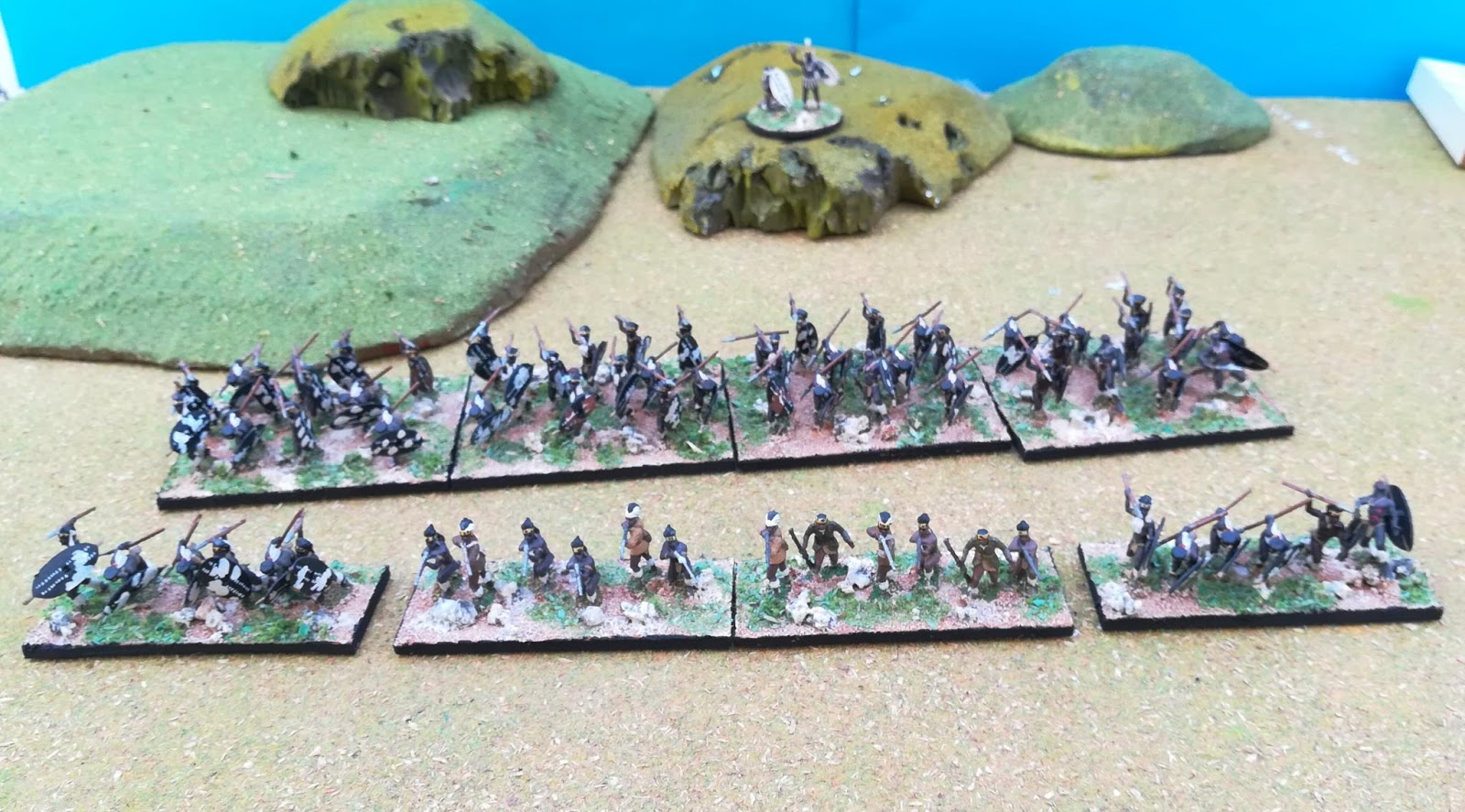
After finding the Anglo-Zulu Wargaming group on FB I decided to rebase my Zulu army according to  Battles for Empire 2 rules which allows the big basing I prefer. Here you can see six different Zulu regiments from ESCI but only one is complete. There are at the moment close to 300 figures out of 1000 that are needed for Isandlwana. I have another 300 ESCI figures in stock and the remaining 400 will have to be HAT. Good news as they look to be the best Zulu 20mm around.
 
 
The figures are all ESCI but many were transformed in order to loose the exagerated decoration in the head they bring from origin. Cethswayo ordered his warriors not to use that decoration which was mostly cerimonial.
 
 
 Unmarried regiments sport their dark shields occasionally spotted with white.
 
 
Each regiment for Battles of Empire  2 rules has four units, each of 24 figures. Three of these four have two bases each of 12 figures with each base being 80mm by 60mm. One unit which is rifle armed, though only 12 figures out of the 24 have rifles, is on four bases each with 6 figs and 80mm by 30mm. So when they are together they are the same size as a normal Zulu unit (Paul Barnett text).
 
 
In some of the half bases for rifles I placed a shielded warrior as a commander. 
 
 
 One of the married regiments are conversions from the ESCI figure that is kneeling to fire. İts rifle was taken out and replaced by a hand weapon and shield. The kneeling firing figure is the closest I could find to the warriors placed in reserve at the back center of the battle line that in order not to hastily charge the enemy were ordered to remain seated and with its back to the opponent.
 
 
The 'shaven' heads of most of these warriors.
 
 
 Many of the figures in the ESCI box don't have enough shields and I made many in plastic card.
 
 
Casualty markers made from poker disks (4X4cm).
 
 
 The famous Horn, Chest and Loins formation designed to envelop the enemy.


A full regiment for Battles of Empire 2 rules.  
 
Next: the British army at Isandlwana.