Monday, 2 July 2012

Rapid Fire! Battle of Arnhem Buildings in 20mm size

 Arnhem is always on the mind of any WWII buff. Since I was a little boy and saw the movie "A bridge too far" I got hooked. All that desperate courage and folie from both sides was amazing. Besides, guys jumping out of airplanes was always crazy....and that never ending bridge... Then, Airfix 1/76th scale British paratroopers did the rest, even if they were filled with mistakes, that me as a teenager couldn't see.

But it was only when Colin Rumford released in 1999 the Operation Market Garden supplement that things got serious and since then I collected, built and painted every single unit to RF! scale in 20mm (at least German and British, Americans have to wait)  and most of the buildings, at least the most famous.

It´s the buildings I will show you now. They were photographed in a random way with no particular order, only the one I used to take them out of the shelves.

The buildings are scratch built and made out of foam card and other DIY cards, with some wood, stones, etc, for details. Bases are plywood.


The Hotel Dreijeroord (White House, as called by the British paras).


 All buildings have detailed interior, or at least some space to place figures based to Rapid Fire! standards.


The roof and the building are united together by some blobs of Bluetack or similar never-drying material.


 There are some of the bombed houses near the bridge, based on very old B/W photos.


 Some exceptions: Dapol plastic houses just builted and painted to look like Dutch houses.


 These houses too can have figures inside as the plywood walkaways are the base for the Dapol buildings and have small plastic parts at the corners that make the buildings fit nicely.


 Another exception are the resin Zwarteweg houses were General Urquhart hide (Timecast 15 mm houses, good, at least for me,  for 20 mm games as houses should be smaller than real so they don´t hamper movement).


Backdoor of the Zwarteweg houses.


 The Ommershof near the railway. Painting is conjectural as I could only find a photo of the place in the Market garden  Then and Now books.


Hotel Johanna in the Pietersbergseweg, Oosterbeek.


Hotel Schonoord in the crossroads, Oosterbeek.


 The Municipal Museum with its funny and challenging shape. A Kinder egg helped for the cupola...


 The Gasfabriek at Oosterbeek.


The St Walburgis Cathedral. The consequences of the crashed German FW-190 that destroyed it partially are still missing ...


 The St Elisabeth Hospital.


No 20, Pieterbergseweg.


The MDS station ("Quatre Bras") at the crossroads, Oosterbeek.


Hartenstein Hotel in Oosterbeek.


 The Hartenstein Hotel with its tennis court. 


 The Taffelberg Hotel, in the Pietersbergseweg.


 The Official building west of the bridge.It served as brigade and battalion HQ and Col. Frost was surely one of his frequent visits in those days.


A very nice piece to build.


 The bridge itself.


 The arches are plastic from electric stuff and most of the bridge was built in stout wood as its too long to be built in softer material. It also needs to carry many resin, plastic and metal vehicles of Graebner´s command and allied counter attack.


The bridge is more then 1 meter long and I divided into 3 parts for ease of storage.


Used bibliography:


 The Then and Now 2 large books on the Market-Garden Operation. Without it everything gets less reliable.


BattleGround Europe books. Very good info too.


 More easy to find books. And good to start.


De Lillio´s inspiring book on modelling Arnhem.


 And where everything started. With its tasty pics and clear text its a must for RF! fans and even for others who like to drool at nice wargames pictures.

 Look also in the net for hundreds of articles and good sites for this fantastic campaign.
For instances:


and...


...or this one.


Sorry, the article is really "a bridge too... long".

Sunday, 1 July 2012

Lebanon 1982, 1/87th &1/100th scale Syrian SA-2 Guideline and SA-3 Goa (painted)

This is the final post of  the SA-2 and SA-3 Syrian systems with all parts - missiles and radars- already painted.


The SA-3 GOA system was uniformely painted with a scheme inspired on some of the 1973 T-55, with a green base with blotches of sand outlined in black.


 The SA-2 Guideline was painted in another uniform scheme more used in Lebanon by many others AFV´s, green base with blotches of sand and (a little) grey.


This camouflage scheme is the one present in many of the Damascus Tishreen museum  AFV´s and weapons systems.


Tuesday, 26 June 2012

Lebanon 1982, 1/87th &1/100th scale Syrian SA-2 Guideline (cont.)

These SA-2 Guidelines were made out of the usual materials: The rockets itself are aircraft missile plastic parts "frankensteined" from different kits and evergreen tubing and the bulky green part is made out of three 3 milimeters soft styrene sheets glued and sandwiched together and then carved with X-Acto.


 The full SA-2 Guideline battery with the Fan-Song radar.


The SA-3 Goa battery with the SNR-125 Low-Blow radar.

Monday, 25 June 2012

Lebanon 1982, 1/87th &1/100th scale Syrian SA-2 and SA-3 AA Missile systems


The main missile AA systems used by the Syrians in the Bekaa valley were the SA-2 Guideline and the SA-3 Goa attacked by the Israeli aviation in Operation Mole Cricket 19. The problem of using models of these things , as usual in 1/87th scale in particular, is availability  and price.

As my collection mixes 1/87th with 1/100th scale, scratchbuilding models to these scales is nice as can can always say the model turned out in "1/90 th scale" or in "1/88th scale", who knows.

The model above and in the next two pictures is the Low Blow radar attached to the SA-3 batteries.


The wheels are metal Irregular Miniatures from their Useful Range Artillery. The central control box is a piece of styrofoam (don´t forget to protect it with a thick coat of PVA glue before spray, or you will get a really small box...). The ladders and such are metal. 


The Radars themselves are Made-in-China toys and most of the details are the trustable Evergreen plastic tubing, sheet and rod along with other styrenes.


 This is the way how I produce quick reference for scratchbuilding: Google + attach images to word page + print =  that´s it.


 Try to capure images from the best angles and particularly B/W  and almost-to-scale images. Many times you can even use a ruler for measurements if the pic turned out in the wanted scale.


 The SA-3 themselves: several parts of 1/72nd aircraft missiles until you are satisfyed; Evergreen and other styrenes for other parts and you are done with it.


Same recipe for the Sa-2 radar, the SNR-125 Fan-Song. Much more complicated than the previous radar, this one has more parts in styrene. Superglue and Hotglue bonds everything in its place. The figure, a kneeled Skytrex 15mm already glued, gives you the size of the thing.


Next: SA-2 Guideline.


Tuesday, 19 June 2012

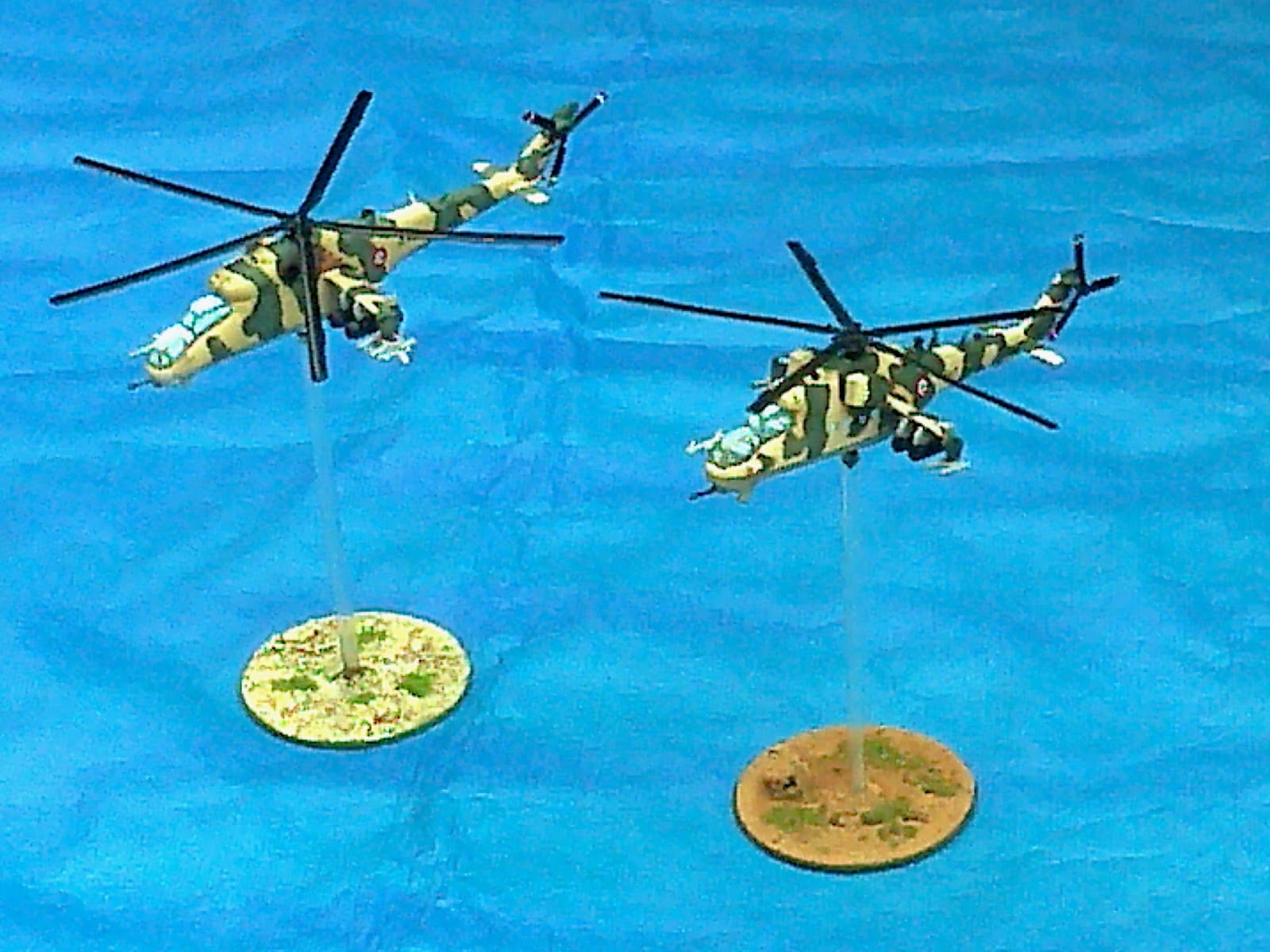
Lebanon 1982, 1/100th scale Syrian Mil-Mi -24 Hind helicopters

These ones weren´t really in Lebanon in 82 but they already belonged to the Syrian military. It were the Aerospatialle Gazelles who bore the brunt of all the helicopter fight on the Syrian side and with considerable sucess. The Hind crews were still training with their new machines. Based on recent footage available on the Web the camouflage is still the same after many years of Hind service in Syrian hands.

JMM: they already have some air support....


 This one is the 1/100th metal and plastic (die cast) Italeri Hind released with a magazine many years ago. Only now I looked at it with attention and repainted it in Syrian colours.

 
A few milimeters larger is the plastic Hind of Revell. I chose to paint the windshields because there are just too many kits of airplanes and AFVs in resin and metal in which we have to paint the glass parts that I feel this is the best thing to do. Of course it´s a pitty to spoil all the interior detail and the possibility of placing some crewmen, but it´s one of two options.


Sunday, 17 June 2012

Rapid Fire! Italian Desert, 1/72nd scale Sahariana

Just two recent Altaya Saharianas repainted and based, with extra crew, guns  and stowage.


 The one on the right also had its Breda 20mm gun replaced by a soft plastic 47mm gun from Waterloo 1815 Folgore Division box given to me by JMM. Thanks friend.


 The figures are mainly russian and american hard plastic bodies with different heads some helmeted and other with caps slightly carved to look like italians.

Saturday, 16 June 2012

28mm AOE Waterloo 1815 11th Cuirassiers

After looking for some different Cuirassiers Regiments I found that there were some that didn´t sported the breastplate. That was the case of the 11th regiment. The Perry box has all its excellent models with cuirasses but the Perry dragoon´s are good for these conversions.


These figures represent the 11th Cuirassiers of Guiton´s bgde , III Reserve Cavalry Corps. So my III corps will be added with this regiment and one of the previous regiment (red collar) will pass to Milhaud IV Reserve Cavalry Corps and will represent Travers bgde.


 The main conversions to change dragoons into un-cuirassed cuirassiers is to place cuirassiers heads and place a Greenstuff rolled blanket on the torso. Also some Greenstuff epaulettes on everybody shoulders and that´s it (or just use Elite dragoons straight from the box).


In this way the repetitive task of building all Cuirassiers brigades in Waterloo gets a little more enthusiastic.

Friday, 15 June 2012

Lebanon 1982, 1/87th &1/100th scale Syrian T-62

My dear friend JMM, the artillery was not the last post for the Syrian of 82, but this one will be: the T-62, which by this date was the most important tank in their arsenal, at least numerically, and the mainstay of the 1st armoured division.


First some of the T-62 , left the T-62A (without MMG), transformed from the excelent Petner Panzers plastic kits from the USA in 1/87th scale and right, the T-62M, . This brand I think no longer exists, and I only know two kits made by them: the T-72 (same mould as the one once made by Roco...) and the T-62. I remember building the T-62 plastic kits (18 of them) and feeling glad on how all pieces glued so well, making me think these were the best kits ever. Besides the tracks were one piece, and some 15 years ago were some of the first to be seen (ahhhh... the Airfix Bren Carrier is some 40+ years old, right...?).


 The Petner Panzers T-62 fleet, is this case the 76th brigade of the 1st armoured division.


 A different camouflage, without the grey colour.


The Salvat 1/87th scale T-62. Each I find turns into a command vehicle with a little Syrian flag added.


 The Skytrex 1/100th scale T-62. This is the beginning of the  91st brigade for the 1st armoured division.


The full T-62 armada.

Thursday, 14 June 2012

Lebanon 1982, 1/87th &1/100th scale Syrian towed artillery


130mm M46 guns and crew by QRF and a few Peter Pig (1/100th scale).


152mm M37 guns by Irregular Miniatures (from its Really Useful Range). Crew are Peter Pig and QRF.

Wednesday, 13 June 2012

Lebanon 1982, 1/87th &1/100th scale Syrian T-55

The T-55 was still in good use by the Syrians in the 1982 Lebanon campaign, but was already beeing replaced by the T-62. Nevertheless was still used by the 58th mechanized bgde of the 1st armoured division, the tank battalions of the 85th infantry bgde and of the 62nd independent bgde.


The first is a pair of 1/87th scale Salvat collectibles repainted for some of the T-55 of the 85th Inf. bgde seen in Beirut.


 These ones are CMSC 1/87th scale and sport several camouflages, including the 1973 scheme of brick red/sand/ and green outlined in black.


 This pair is Roco 1/87th scale. In the previous and following picture you can see the many details added to these old kits: figure; drum barrels; MMG; antennae; search light and stowage.


And now for the 1/100th models. These two are  Skytrex and really nice.


These four are Eko and had the same amount of added details as the ones from Roco in 1/87th scale.


The full group: the 10 of the top rows are for the large battalion (5 companies) of the 58th mechanized bgde; the 6 of the bottom row is for any of the other tank battalions (3 companies).