Friday, 10 February 2017

Rapid Fire! Spanish Civil War in 1/72nd scale - Republican artillery and cavalry


Near Dos Molinos the Republican artillery deploys before the advancing Nationalists. But here they 'No Pasarán'.


The box of the FirstToFight 75mm Schneider gun comes with a pair of highly detailed model guns. When I first looked I thought some kind of mistake hapenned and FTF got them in 1/100th scale or something like that. But no, after some measures I concluded its the others I have from other brands that are a little bit on the large size.

The crew are Irregular Miniatures and they go well with the guns.


Also four HAT Russian Putilov 76,2mm guns also joined the defense of Dos Molinos.  The models are simple but a pleasure to build with only a few pieces on the contrary of FTF guns.


These are the limbers, now painted, from two posts ago.


For the spanish artillery green I used GW Waaagh!Flesh - damn stupid name, but very close to the true colour I saw in Spanish museums.


The cavalry mixes the until now useless Hasegawa cavalryman and Revell Cossacks with Adrian helmets.


Next: armour, probably.

Sunday, 5 February 2017

Rapid Fire! Spanish Civil War in 1/72nd scale - Aircraft for Nationalists and Republicans


In a stormy sky a Nationalist Cant Z 501 prepares to get to its naval base while passing over the village of Casa Sola.


The model is the old but still very nice Italeri model. All insignia and numbers are hand painted (it shows sometimes...).


From KP came this Czech Aero A101. The Nationalists captured a batch of them inside a Republican  ship and used them against their previous owners.


Top ace of the war, Comandante Garcia Morato, on board of its Fiat CR.32.


Supermodel model (can I say so?...).


 Directly from France, and apparently using the same aerial corridor of Casa Sola, here it comes a big Bloch MB200 from SMER on the service of the Republican airforce. Again no interiors and painted windows which speeds painting procedures a lot.


The more modern Bloch MB210 from Heller also arrived just in time before French government cut the weapon support for the Spanish Republican. 

The positions of France, England and USA (with a strong catholic lobby in the Senate and White House and plenty of oil sales to the Nationalists) during the conflict were shameful. As democracies they should have helped the Republic, but instead they bought the promisses of non-intervention of both Germany and Italy, which of course were broken almost immediately.

 In the end only the USSR and Mexico gave assistance during most of the conflict to the Spanish legitimate government and Hitler and Mussolini came out of this war with enough confidence to do what they did in the next few years: WWII.


Friday, 3 February 2017

Rapid Fire! Spanish Civi War in 1/72nd scale - Artillery limbers


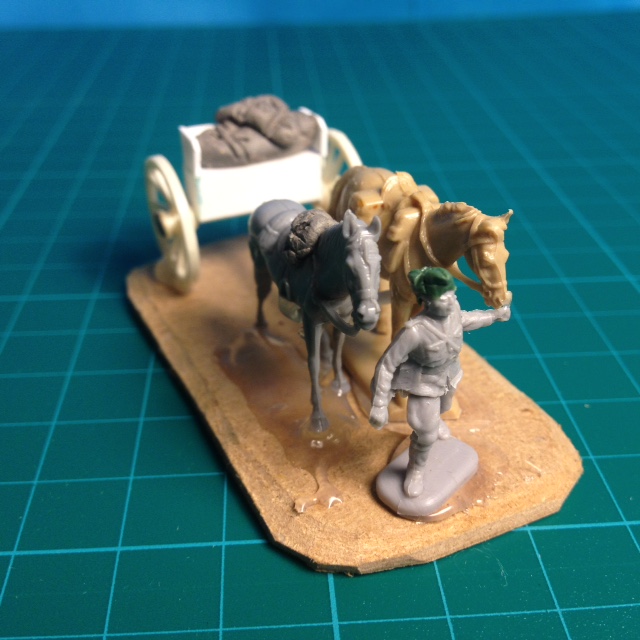
During the SCW most of the artillery was still horse drawn. But I couldn't find anything dedicated to SCW. So I made them myself using bits and pieces.

 
The limber is made of Evergreen with Revell SYW wheels from its artillery set. Taking photos before painting is good to discover some flaws and the strange hair Trump's stlyle of the walking artilleryman was already taken out.
 
 
The artilleryman is an Russian Esci Cossack. It has a new Isabellino cap and an open jacket after X-Acto surgery. The sword was taken out and a blanket was placed in some of them.


The horses are all Esci Russian both from the infantry and Cossack set.
 

Some blankets and extra stuff was placed in the seats. I caught a picture of the Nationalists entering
Seville and the 75mm guns are being pulled by similar limbers to these ones and only by two horses.

 
Next:  Some planes, probably. Or artillery.

Wednesday, 1 February 2017

Rapid Fire! Spanish Civil War in 1/72 scale - Badajoz, 1936


Badajoz was conquered by the nationalist in their quick summer march of 1936. It ended in a bloodbath where the worst atrocities of the entire war probably happenned. When asked by foreign reporters after the war, general Yague, the commander of the attackers, said something like "what could I do? Follow to Madrid and leave 4000 enemies on my back?". Simple. Apparently the notion of POW was non existant in Yague's mind.


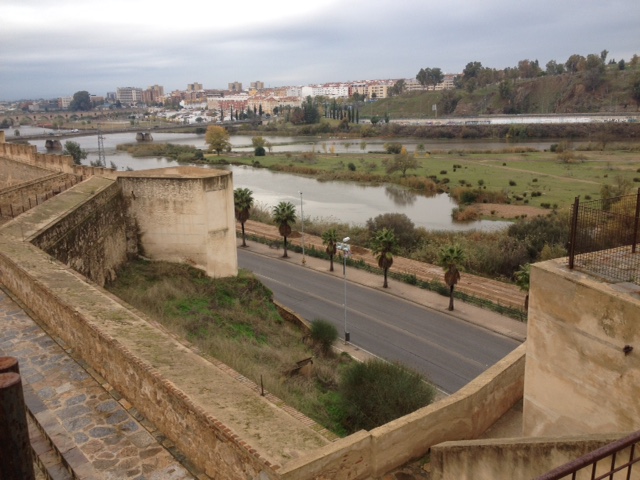
From the two photos above you can see the view the Republicans had of the advancing Moroccan Tabors who were encircling the city from the north heading to the Porta de Carros. The walls of the castle were still from the time of the fierce assault of the British in 1812 against the French garrison of General Philippon.


The steepness of the walls forced the attackers to look for more advantageous points of entrance.


The neighbourhood of  San Roque  was the assembly point of the II Tabor of regulares de Tétuan.


In the mean time,  4th Bandera charged Puerta de la Trinidad, in the south wall. This view is from the outer part.


This view here is taken from the inside of Puerta de la Trinidad. Plenty of information about the construction of this part of the wall but nothing else...


There were two HMG on the walls that poured deadly fire into the ranks of the 4th Bandera but the Legionarios managed to force the gate. 

As usual in Spain these kind of places have no plate, no description whatsoever about the Civil War events.

 History from 1939 up to 1973 was written by the victors who effaced all traces of their blame in the dreadful events of the period, placing the enphasis on the Republican killings of priests and nuns and the destruction of clergy property. The problem is that, while true, the Republic was in power due to an electoral victory of the Frente Popular, and the Nationalists were in fact outlaws that didn`t accept the result of the elections and who chose war in order to change that result. Besides, the killings by the Nationalists amount to the 150.000 (Paul Preston data, and not counting the horrors of Franco's regime up to 1973) and that of the Republicans to 37.000 in their respective areas. 

Even the killings of Paracuellos, in which the Republicans shot several thousand, were made on nationalists military personnel who openly denied to fight for the government of their country - that is, the Republic of Spain - and that would have suffered on those days the same fate in many countries of Europe and the world, as military discipline still predicted death penalty for the military.


In the Calle of San Juan, journalists counted over 300 dead people killed in the next few hours after the Nationalist victory. Rape and theft were also rampant. Badajoz lost 10% of its entire population.


But the worst place was the bull fight arena were the killed may have amounted to several thousands. The inscription read "the hugliest bull fight arena of Spain".


Viva la Republica! You can still read this in some parts of Spain after all those many years. Again no information for a visitor. After Franco, during Filipe Gonzalez long government  and nowadays, even with amnisties, the debate about what to do with the memories and living realities of the Civil War arrived to a dead end and the Spanish people buried the axe a little bit like we, the Portuguese,did with the PIDE agents of Salazar regime.
Is it fair to the memory of the killed?


Friday, 20 January 2017

Rapid Fire! Spanish Civil War in 1/72nd scale - Republican Infantry (EPR).


Those BUM miniatures are really hard to find, no? There are no other plastic SCW infantry, right? Right. But if you give a good look at the most common plastic sets available you will see that some quite passable infantry is not hard to convert.

I saw on the web some modellers using the Hat WWI Austrians and Serbian boxes as the basis for Republican Spanish. It's a great idea but I didn't have any of them around so I used mainly converted figures.

The action takes place in the village of Casas Amarillas (obviously...) and you can see an EPR (Ejército Popular Republicano) battalion with 4 companies, 3 of them rifle and one HMG.


They are are mix of metal Irregular Miniatures with WWI and WWII Esci and Revell plastics, as I did with the Moors.


The Republican infantry used the Spanish Trubia, Czech and Adrian helmets besides the Isabelino cap and other headdress namely the Pasamontañas cap (very close to the Austrian WWI cap). For the Trubia I've used the heads of German Revell WWI figures, the  Esci Japanese for the Czech helmets  and for Adrian helmets from both Airfix and Esci heads.

On the mortar you can see (L) an IM figure, the mortar firer of the Esci WWII Russian set (with a Trubia helmet and opened coat to look like the guerrera) and an Esci US WWII mortar crew with GreenStuff Isabellino cap.
The Hotchkiss group has (L) the observer with the body of the Revell WWI German figure with an Airfix Adrian helmet; an IM firer and another Esci US HMG crew, again with Isabelino cap. The Hotchkiss came from the Esci Japanese with scratch built tripod.


The light mortar (with plate added) is an Esci Japanese with Revell German WWI head and PPD sub-machine gun on its back carved from a PPSH 41. The command set is a Russian officer and the Australian radio man, both Revell. To the right another IM figure.


The LMG's sets are made of a mixture of Japanese, French and Russian, all Esci both hard and soft plastic.


From left to right you have a Russian Esci and two IM figures. The fourth figure is made out of Russian legs and a Japanese torso all Esci. The two last figures are a Revell US marine with a Czech helmet and a Esci WWII French with Trubia Helmet. I used the Revell US marine uniform because is quite similar to the mono used by many Republican troops.


More of the same. The fourth figure is an US Matchbox venerable body with Trubia Helmet. The last of them is again another Frankenstein with Revell Marine legs and Esci Japanese torso.


Metal and plastic happily living together is the same stand.


Some of the figures got an EverGreen blanket roll which desguises some faults on the uniforms.

On the modelling table I have planes, artillery, tanks, cavalry and infantry some half done other half painted. More stuff to do than time available... Where did you hear this story?

Friday, 13 January 2017

Rapid Fire! Spanish Civil War in 1/72nd scale - Moorish Tabors from Larache.


This action happens close to the village of Quatro Casas - as you can conclude from the above picture - and it portrays the two dreaded Moorish Tabors (half battalions of 2 companies of infantry and one of cavalry each) of Melilla, east Morocco.

The Moors were coming from North Africa and belonged to Franco's African Army who became  famous for the first history's airlift (with Hitler and Mussolini's help), its fighting prowesses and also its cruelty.


The figures gave me lots of pleasure to build as I could do what I like the most: converting, that is building armies without becoming broke! (of course I would prefer to be rich, order everything metal and send scratch building and converting for a big walk around the park!).

In the mortar stands I used two metal Irregular Miniatures figures, here with fez, and one plastic. These last ones got a little tricky as the torso and mortar comes from the Esci WWII US mortar figure and the legs are from Revell WWI Germans. The head is the original Esci with a GreenStuff turban.


Cheap Chinese copies of Airfix Japanese and US Marine were turned into Moors again with GreenStuff in the turban and bed roll. The blanket roll was quite used in the SCW and helps desguise imperfections and particularities of the uniforms.


German WWI Esci MG 08 crew with head from Esci Muzlims. The HMG firer is from the Esci US WWII box complete with gun; the helmet is carved to become a fez; the blanket roll hides many different parts of the US uniform and equipment. Pay attention to the HMG crew who should always be Spanish so no turbans. Here I only placed a Spanish as the firer, all other are Moors.


All non-metal figures are these kind of conversions. The basis is mostly Revell WWI German bodies with heads from the Esci Muzlim set.

Loctite Special Plastics gives a good bond to soft plastic parts and was used in all figures needing a new head.


The command stands have figures from the Atlantic WWII Russian set, again converted, Revell and IM metals. The Flags are simple prints from the internet.


The cavalry are based on the Zvezda Turkish cavalry. Some carving, two blanket rolls (on the horse and horseman) and a rifle/SMG made the rest. The Ottoman tuban also had some cutting in order to make it smaller.


Tuesday, 3 January 2017

Rapid Fire! Spanish Civil War in 1/72nd scale - Early Republican aircraft


Now for some aircraft of the SCW. The village of Dos Casas is again the setting and the local inhabitants must be thrilled about all this crazy activity in their, until now, quiet place. 

All these models are plastic and some have resin parts. Fortunately the fiddly resin parts are mostly for the interiors and were discarded by painting the windshields. No decals on any of them as I prefer to paint the symbols. Paint always sit on the place we want, well, more or less. 


This is the Lockheed Orion from Special Hobby. Only some 3 were used by the Republicans, one of them Mg armed. The plastic is a bit rude and it has some resin parts to compensate. What doesn't compensate is the price which is too high for the quality of the plastic. But it was easily available at my local hobby shop and when you have the fever it really doesn't matter? Right...? (please say yes...).


The Letov S.231 (KP model) was a bit more common with some 17 flying for the Republicans.


The Nieuport 52 (Azur model) was license built in Spain. Some 56 were active when the Spanish Civil War broke out. 


The Fokker F.VII (Valom Model) was a rare bird also. I regret having built and painted it in this postman look as there was a much nicer version with a Mg in central fuselage which made it more menacing.