Thursday, 4 June 2020

Rapid Fire! Eastern Front in 20mm - The South Ozereika landings (part 2)


Now its time for the transport of the first wave of Naval infantry. The first 300 men intended to arrive at Ozereika beach were carried by six of these MO4 Submarine Chasers. Things went bad from the beginning as the MO4 transporting the officer in charge (051) of the first wave assault troops and another ship were destroyed before reaching the shore and 1/3 of the initial assault force was lost. 


The MO4s were made as usual slightly smaller than reality, Less windows were thus glued to the side of the boat and the 12,7mm AA guns were discarded.


 This is a photo of an original MO4 slightly longer some 6-7 cm than the models showned here. You can find all angle drawings of the MO4 in the excellent site Engines of the Red Army.  


Many details were discarded in order to have space for the Naval Infantry stands. The depth charges are leftovers of the Matchbox Corvette and were placed on a new structure. 


Each of the six 47mm guns were made from tubes of the Esci Flak Vierling 20mm gun. An extra barrel on top, deck support and wheels made the final result which became reasonably similar to the original.


One of the aims was to have enough room for 20 stands of figures and many details were made shallow for not to disturb the balance of the transported figures. 


Only one figure was placed manning the 47mm guns as a space saving measure. 


The Revell sailors had new arms to fit the new function. 


Once again Blue Board and card was used in the bigger structures and bits of chain, EverGreen plastic card and metal tubbing were used for details. 


The windows were made with a paper punch. 


The hardest part of these kind of models is to get the right shape of the bow. After some practice and some rigid calculation you manage to use X-Acto on the Blue Board in the correct way followed by some careful sanding. If you fail, don`t worry, there is always some more Blue Board in the construction yard near you. 

Next: An interruption in Ozereika and a return to Arnhem oddities.


Saturday, 30 May 2020

Rapid Fire! Eastern Front in 20mm - The South Ozereika landings (part 1)


The landings of the 255th Naval Infantry Brigade and of the 563rd Independent Tank Battalion at South Ozereika, February 1943, became famous in Russian military history not only by the courage and sacrifice of the attacking forces but also by the way it failed. Like Dieppe, this landing is taught in the Russian military academies as a way NOT to perform an amphibious landing.

This time, while coming back to Rapid Fire! light blue book ("Bavarian blue" as a Napoleonic buff would say), also known as the third supplement, I was hooked by the tasty VI page were you can see the bow of a large landing craft in the Ozereika landings.Years ago a lot of time was lost trying to find precise information about Russian landing craft only to come empty handed. Probably there was plenty of material in Russian language but nothing in English and much less in Portuguese. Nowadays much more information exists and I strongly recommend the site Engines of the Red Army made by Oliver, a fantastic artist and researcher. Here is the link for this particular operation:   https://www.o5m6.de/redarmy/m3a1_osereika.php 
 
Regarding Ozereika I found in the stash a KP PO-2 aircraft, an ICM TB-3, Hat Romanians and Pegasus Russian naval infantry. But the main attraction for me are the landing craft and support vessels. So, more scratch building on the way! Besides who can resist Russian naval infantry carried in Swedish barges with US made tanks fighting Romanians and German Jägers? I can't for sure.


Three old Bolinders, old barges from Czarist era, were used to transport 30 M3A1 light tanks and a few trucks.  These old barges were one of the reasons for the failure of the operation as they were slow and hard to maneuver (the original Bolinders engines were finished) and they had to be towed by minesweepers and then, closer to the beach, by smaller tows.


Blueboard was used for all major structures and wood and plastic for the smaller ones. The size of the real thing should have been 1 meter long but the model was kept at 45cm, enough to carry 3 tanks and 1 truck. 


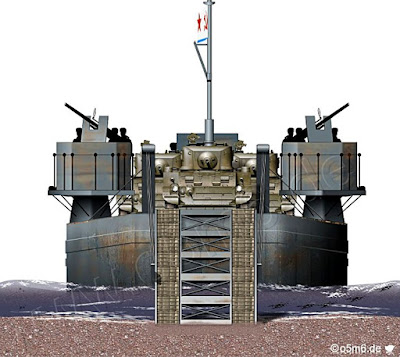
This is the aim (picture taken from Engines of the Red Army blog).


The bow of the Bolinder is equipped with two scratch built AA guns. The ramp on the bridge was built with parts from the Matchbox AVRE Churchill. 


The correct waving shape of bow and stern was kept aside for speed of construction. The image is taken from the blog Engines of the Red Army.


The Soviet sailors came from the Revell box of Kriegsmarine as the uniforms are very similar. The arms were carefully cut out and placed in a way it looks they are manning the guns. 


The stern of the boat was reduced to a minimum of details as I couldn't find much information.


All masts mast are barbecue sticks. Doors and windows are card. 


The ready lot. All Blueboard parts took two layers of PVA glue for it to cope with the acrylic primer spray. After the primer Vallejo Blue Grey was dry brushed all over.  


The Bolinder number 6 was towed by the minesweeper T-412 "Areseny Rasskin". 


The final model is no more than a caricature of the true boat. Over 1 meter was necessary to represent the real thing while this model is 35cm. This last lenght is an obvious compromise when you need a gun, a control tower, a chimney, vacant places for naval infantry and depth charges all in the same model.


This is a correct model with the elegant lines, albeit in a smaller scale,  of a Fugas class minesweeper. 


One of the reasons to build a Russian minesweeper is that Master Richard in his Bavarian blue book mentions a "102mm gun" from a destroyer as support. This model can be used both as a Bolinder tow and as a support weapon. The gun came from the Matchbox Corvette and the artillerymen from the Tamiya modern torpedo boat. 


Much of the deck is free of details for several stands of infantry to fit in. 


A few more Revell conversions were used to man the 37mm AA guns at the stern. 


The lifeboats are Blueboard, other parts came from the Matchbox Corvette, the stairs are Airfix from the Commandos box and the flags are hand painted.


A few more pictures as my English is finished for  now!...


Next: Part 2 of the South Ozereika landings. 

Monday, 25 May 2020

Rapid Fire! WW2 Late War Eastern Front in 20mm - Soviet tank force up to now


A large Russian tank force gathers around the German village of Karl-Heinz-Rumenigge not far from the twin villages of Klaus Allofs and Horst Hrubesch on the way to Berlin (this one really exists!). 


Up to now this Tank corps has a full T-34/85 brigade, two JS-2 battalions, two SU-85 battalions and one ISU-152 battalion. The T-34 numbers are far from complete and I´ll try to find two more brigades. In fact I have seven other tank brigades that you can see in the Kursk posts about Mid-War made of T-34/42 and T-34/43. These were getting rarer in late war environments but that can still be used. All other material, artillery, infantry, etc can also be taken from my Kursk forces.


For reconnaissance you can see two Scout Companies with a White M3 all from the Lend-Lease program.


The Ford GPA are repainted 1/72nd die-cast models quite common around here a few years ago. I found four and they are nice renderings of the true machines. The figures for this command version is Zvezda (driver), hard plastic Esci (commander) and soft plastic Esci (female radio operator). There must be a problem with the driver as he prefers to look at the Officer's ass instead of the beautiful blond on his back... well. 


This one got a Maxim HMG based on this picture from the fantastic site Engines of the Red Army in WW2 


The Esci White M3 for the Recce command. 


Two of the battalions of T-34/85 are Pegasus 1/72nd scale double kits. For me they are the best way to portray these great machines, cheap and very detailed with very good tracks waving along the wheels. 


"01" is the command tank of the brigade and has extra Esci and Matchbox hard plastic figures as Desant infantry and a Fujimi tanker. 


The third battlion is Fujimi. "203" is Frontline Wargaming and joined the Fujimi models as all are 1/76th scale.


The two battalions of SU-85 from Fujimi. The tankers are Fujimi and Skytrex.


This battalion of JS-2 is Italeri from the its double box. The DShK Mg's are scratch built (c'mon, I had to scratch built something here). 


The other JS-2 battalion is made of beautiful repainted Altaya models. The tank commander is Britannia.


Finally, the ISU-152 are Italeri also from a double model box. 


Next: wether WW2 Soviet naval forces, Part 3 of Arnhem oddities or France 1940.

Friday, 22 May 2020

Rapid Fire! Market Garden in 20mm - Oddities and such (part 2)


For years I´m also trying to make Kriegsmarine infantry. Unfortunately by the Arnhem campaign the soldiers of the KM Stamm were using Heer uniforms with a few very small yellow navy distinctions to make them different from regular infantry. So I decided to go back two years and use proper navy uniforms for land combat! 
The first inspiration came from the nice cover of 1/35th Dragon box of German Naval Infantry at Dieppe. Also having Naval German infantry to fight all those early Churchills from the Calgary regiment fits my wishes of making the entire Dieppe disaster in the future. Besides, dark blue jackets and white trousers in WW2 ? Irresistable!


I dont have any book dedicated to the KM Stamm so all information came from the internet with the associated risks. This nice picture on the is from a French museum and guided me all along the painting. I didn't paint the two rows of yellow buttons because I used figures from normal infantry.

To the right I think this is the true uniform used by the Kriegsmarine men at Arnhem. But, as you can see and exceptuating the yellow details, they look too much alike their army mates.


A total of 60 figures, two battalions, are enough for the Dieppe raid or any scenario of the Market Garden campaign.


The figures are all plastic from Airfix, Matchbox, Esci and Revell. I managed to find a place for the nice Airfix Luftwaffe aviator in the KM as the radioman you can see top left. The MMGs were scratchbuilt as well as the firer which used parts of two different figures from Matchbox. 


Each company has 8 figures and again all plastics are involved. I glued the Esci and Revell figures to the bases with PVA glue but the Matchbox, slightly smaller, were glued with a glue gun to become a few milimeters taller. The MGs34 got a bipod due to the strange habit of some Esci figures having it "in the air".


The other command stand is more at ready and has a radio man converted from Esci with two other Matchbox famous figures.

Next: A return to France 1940 or a Late War Soviet tank force.