Sunday, 22 December 2024

Rapid Fire! Russian houses and Orthodox church in 20mm


All these houses and church were made from those cheap Christmas houses sold in decoration shops. Frankly, I hate Christmas. And this has to do with our toys. When I was a kid, probably from 8 years old on, I would grab the money my family gave me for Christmas, after waiting for some two days for toy shops in Coimbra´s Adelino Veiga Street to re-open after the "balance" of countability - something the computers finished with - and would bring a good bag of them with me. The problem was seeing other kids of my age looking at the window´s shop without being able to buy anything. Since then Christmas is for me the symbol of unfairness and injustice. If it wasn´t for my kids, my wife and my mother that love this season I would skip it totally, going as far as possible to a place were there isn´t Christmas. Another problem was that I would bite my nails year after year for those two days of balance to be over, knowing that I would see those kids again or others like them, knowing I wouldn´t do anything to change the situation. 
 

I was trying to make a Russian church for a long time together with a few Russian houses as I have only one windmill for the Eastern Front. 


Fortunately there are plenty examples in the web of rural Russian churches and I chose one with a lovely green roof as a starting point. 


This one was made by gluing two of those cheap one euro houses together (the same I used for the Dieppe castle). 


Then a table tennis ball, a cut to shape cross from my kid´s lego Bionicle (this time, offered) and a piece of BlueBoard for the plinth made the rest. 


The houses are pre-made of the type with a turn-on light inside. They looked reasonably eastern and they are a start for my Russian houses. Frankly they didn´t come as good as I expected as I should have exaggerated on the wooden look as I did later with the church. 


The rear and side doors were huge but that was reduced by gluing some flap doors. 


The chimneys are small pieces of BlueBoard. All windows got a piece of card from the interior and painted black. 

Next: The Dieppe casino

Friday, 20 December 2024

Rapid Fire! Dieppe 1942 in 20mm (part 5) - The Dieppe gates


The mid XIX century rebuilt Dieppe gates with the famous tourelles were one of the seven entrances to Dieppe. When the Canadians landed, this was the aproximate sight they could see. 


Due to the tourelles the building stands out in the Boulevard de Verdun, the main avenue facing the sea. 


The construction material look like being the same of the castle, that is flint and sandstone. 


This is the aproximate view from within the city. 


There are some steps on this side and more floors than the ones modelled. 


The model was made in heavy duty card with Lego type conical roofs at the towers, the same used at the castle. The rear roof windows are made from pieces of BlueBoard. 


Kermit the Frog? 


The circular towers are made from spent paperboard centers of toilet rolls as I had no more large plastic tubing which was all used in the castle towers. 


This famous picture shows the three buildings I want for Dieppe specifically: the towers (centre left), the castle (top centre) and the Casino (right).  


The building was heavily shrunk and only three floors (instead of the original four) can still be seen at the front facing the see. Even so the gate and windows are enough for 20mm figures. 

Next: the Dieppe casino, probably, or some houses for the eastern Front. 

Wednesday, 18 December 2024

Bir Hakeim in 20mm for Rapid Fire! rules


Another old project of mine got concluded or at least its presentable. Still missing are some vehicle hidings, a pair of 75mm guns, and Koenig's staff car together with Miss Susan Travers. This was another project with plenty of scratch building and some guessing as the Bir Hakeim compound is not easy to understand in all its details.

Sunday, 15 December 2024

Rapid Fire! Dieppe 1942 in 20mm (part 4) - The Dieppe castle


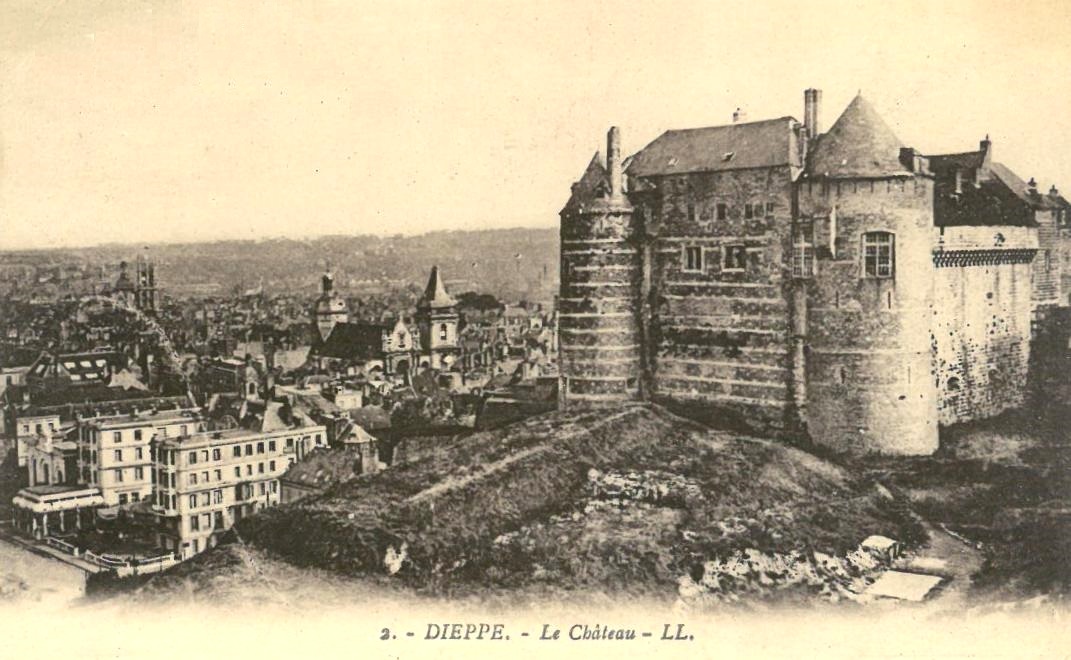
The Dieppe castle is a dominating feature on the battlefield looking east from the top of the cliffs at Western Headland. Its made of flint and sandstone and its reconstruction dates the XIV century. While impressive you can pass well without it as the nearest heavy German defences were placed below the castle in some nearby houses, but it also housed the fire control  of several artillery batteries, hence the reason for this model ( Stab II./ Gren.Rgt. 935 and Stab H.K.A.R 1252 artillery). There were also some MG nests in the openings of the near tower. 


I left plenty of structures out of the model like the bastion facing the beach and the round wall with ramp leading to the main entrance, together with the Ruffin barracks. This was an obvious compromise as the structure is too big to be placed in a normal table. 


The side facing the beach. 


And the original one. Again, the old part of the castle was considerably reduced in the number of adjacent structures. 


This is the side you most see when looking for Dieppe castle in the web. 


This old picture of the same side is precious as shows the old look of the castle and not the pristine one of today as it houses a museum. 


The side of the bridge. 


The real one. In order to shrink the castle some of its parts ended up in a different position. 


The castle was made from Christmas wood houses together with PVC water pipes and even some pieces of toilet paper support. The large number of windows was covered with cardboard.  


This is a simple sketch made as I was gluing each part to another. 


This kind of cheap Christmas houses can be found a bit everywhere and they were the base for this model. 


At one euro each and after using some 6 or 7 of these you have a reasonable cheap model.  


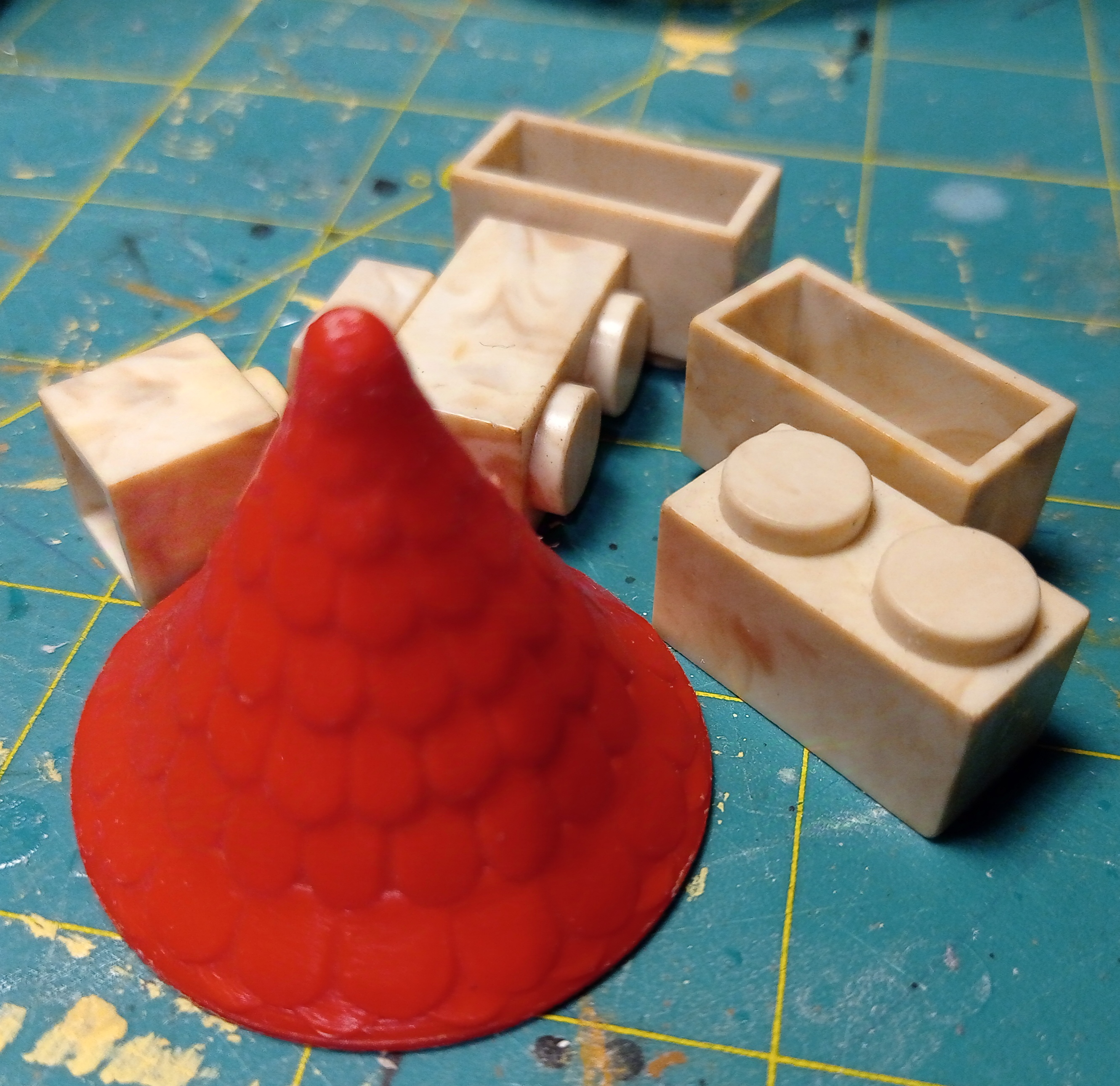
The conic roofs were made from some 50 years old kind of lego parts from a castle. Some arches of the same set were also used for the bridge. 

Next: the Dieppe gates ( I also plan the casino but need more information on it)  or more Angolans for Cuito Cuanavale. 

Impetus Rules - Mohacs 1526, part 14 - One more Rumelian Sipahis stand in 20mm


One more stand of Rumelian Sipahis for the Ottomans. This time they all got basically the same equipment, pennants and painting for the sake of speed as I had other stuff on the table. 


The usage of the same colors on different figures is as quick way to produce these conversions and get a somewhat diverse look. 


The horses and figure´s body are Italeri. Some, like this one, got an Esci head from the Muzlim set with a Greenstuff turban. Plastic shields  were glued and lances were drilled in the hands after squashing slighlty these last ones in order to provide a better and easier drilling surface. 

Next: The Dieppe castle in 1942

Friday, 13 December 2024

Rapid Fire!/Able Archer rules - The battle of Cuito Cuanavale 1987-88 in 20mm - Part 1: What I´ve amassed up to now


The battle of Cuito Cuanavale is part of my youth through TV and magazines together with Iran-Iraq war and Lebanon 82 and it sparks plenty of vivid memories from those dangerous and deadly conflicts of the Cold War. I also had relatives in South Africa and even one that fought at this precise campaign a fact which fueled even more my interest to the Angolan conflict with FAPLA and Cubans facing UNITA and the SADF. For some reason I still could not find the 14 years long Portuguese colonial war (Angola, Moçambique and Guiné Bissau) interesting enough for me to model it. Maybe because it still brings lots of pain to many that are still around, from both sides, and close to me. 

Most of the planes, exceptuating the Mig-23 were made years ago together with most of the infantry. The vehicles, on the contrary are brand new and came mostly from 4D models (yes, I know their Sdkfz 251 is around 1/56 and the first batch of small boxes with tanks were toys but after these the brand made very nice and cheap models and continues to do so at a very fast rate). 

For now I have an almost finished Angolan Brigade with the reconnaissance vehicles and most of the artillery still missing. 

The simple green painting of the vehicles without any crew will allow for its use in other armies of the Cold War period and even after. 


I built 4x T-55 from 4D, enough for the full complement of an Angolan brigade tank battalion (16 tanks instead of the Soviet 30 tanks). The model is a very easy build labeled T-59, the Chinese version of the T-54/55 but, as its an early copy it becomes virtually the T-55. Later the T-59 got many extras which could be seen abundantly in the Iraqi army, for instance. 


 One of the three battalions of infantry in each Angolan brigade was equipped with BMP-1. These three are Eaglemoss die-cast simply repainted and with added rear unditching log and antenna. 


I finished all my BTR-60 - the ones that should be here - and had to use these BTR-80 instead. In fact Angola has 11 of these BTR-80 but they arrived much time later  Cuito Cuanavale. Even so the logic of a simple paint scheme continues for its usage elsewhere. 


The Ural 260 is another non-existent machine in the Angolan army but its not much different from other Soviet models, simply larger and very useful for other scenarios. 


There is a battery of six  BM-21 in each Angolan Brigade. This 4D model is very recent and one of their best. 


The three FAPLA battalions are made from bodies of Esci´s Spetnaz and Vietcongs with all types of field caps I could find (USAAF and even some DAK Esci with the cap´s peak cut). 


Some of the command stands got the brown beret. The 120mm mortar is Valiant Miniatures. 


The typical FAPLA battalion organized for Able Archer with three companies of six figures each and support. 


The Angolan Airforce (FAPA on those days, now FANA) has a number of French and Soviet helicopters like this MIL-MI 24 (Esci?). 


The MIL-MI 8 (SMER) is the most numerous Angolan helicopters. 


The Gazelle (Heller) got anti-tank missiles made of EverGreen plastics. 


I painted blue all canopies of the Angolan fighters and fighter-bombers. This MIG-21 is Fujimi. 


This one couldn´t fit the first family picture and its shown now, a MIG-21 from Matchbox, a much older and not as good model as the Fujimi one. 


This elegant SU-7 is a SMER model. 


The SU-22 (Plastyk)  was the most potent Angolan bomber at Cuito Cuanavale. 


Many MIG-23 (Academy) were piloted by Cubans and they scored several victories over the SAAF Mirages without losses something that  was only recognized years later by South Africa. 

Next: one more stand of Ottoman Sipahis for Mohacs 1526.