Showing posts with label Poland 1939. Show all posts

Saturday, 3 January 2026

Rapid Fire! in 20mm. Filling gaps in WW2 (part 7)


This batch of models plugs some holes in the OBs of several WW2 periods and armies. Retroaranda is a nice Spanish 3d on-line shop that I found while searching for the Vercors Gotha Go 242. They are still using PLA for their prints but dividing these kits into many parts which helps reducing lines and excess plastic. Besides, the kits arrive with all parts clean which makes them easy to build. There are also three kits from First to Fight, namely the funny little cutter KM12, a large 150mm sFH18 and the artillery crew. 

My Ariete division was very short of command vehicles and this lovely SPA Dovunque 35 radio vehicle comes in that sense. 


The kit has no exterior radio system and this one has to be scratch built. This  photo saved me from making too many mistakes on the roof of this radio vehicle. 


On the background of this photo you can see the two biggest inventions of the last decades,  cyanoacrylate and liquid plastic glue, far ahead from Covid19 vaccine and AI. What would be of us all without them? 


Some tracks, stairs and EverGreen plastics were used to improve the model. 


The Ford V3000 radio vehicle was built from 1941-on and will be helpful particularly for the Eastern Front. Only some stowage was added on the roof. The model also brings another antenna for the travelling position. 


This is another Japanese Type 89 Go. The other one I have is from MiniGeneral, made from a different file and slighly bigger. 


This artillery group - one 155mm sFH18  and a 105mm leFH16 -  is the one necessary for the bombardment of Saint-Nizier-du-Moucherotte, 13-15 June 1944 as part of the artillery of the 157th reserve infantry division. I already had several of these artillery pieces but in different colors and environments so a late war summer style group was necessary for the Vercors.


The artillery group who bombarded the Maquis position at St-Nizier made it from a distance of over 5 km and up to an height of over 1000 meters in relation to Grenoble. These stills are taken from the 2nd part of Le Maquis du Vercors- Juin 1944, La Bataille de St-Nizier. 

For the full video see 

https://www.youtube.com/watch?v=aTRyf8seItk

and don´t forget part 1 and 3. 


In this still from the 2nd part of series you can see the St-Nizier heights in relation to the Grenoble valley.


And this is  the today sports park from were the German artillery bombed the Maquis. 


In this other screenshot of the 2nd part of the YouTube Le Maquis du Vercors- Juin 1944, La Bataille de St-Nizier you can see the placement of this artillery group who bombarded the Maquis position at St-Nizier from a distance of over 5 km and up to an height of over 1000 meters in relation to Grenoble and this is the one I´m portraying in RF! terms.  


I don´t have any information on the usage of these Gebirgshaubitze 40 105mm howitzers by the 157 RID as the division had several battalions of Gebirgsjäger. Even so I built these two that can be used elsewhere. 


The crew is FtF with heads from Airfix Afrika korps. There is also one Simon Soldier figure (the one with Zeltbahn) and a Revell conversion that previously was arming a grenade and now is pulling the gun string. 


Other crew for the guns came from FtF and all of them can be used from the artillery box. The seated figures need to bend the legs with heat in order to fit the narrow places on the Feldkanone 16. 


There are some figures with 20/37mm shells for AA guns that were converted to carry the big 150mm shells. That is easy as the FtF plastic is quite easy to carve. 


First to Fight offers the MK12 in 3d printed resin. I don´t know if this one will ever be used in a wargame but the magazine that comes along with the model has some nice stories (recently they are already in english side by side with polish) that can be used as the basis of several wargames. The figures are Revell and Hat WW1 Germans as the Polish sailors had the WW1 Stahlhelm for land combat and even the armored body of the German Stormtroopers, not used here. 


Finally for something wrong. What I asked was one more LVT-A4 in order to have a pair of them to support the Marine landings in the late war period. The designer by seeing the "4" on the vehicle´s name thought that the turret of the M8 75mm HMC fitted the late LVT-4 when in fact the very different LVT-2 was its basis. The "4" just means the 4th way to place guns on the LVT-2 Amtrac. So I got something wrong that needed to be used somewhere. The idea for this conversion came from the following photo: 


One of the few different models from the LVT-4 basic was an ambulance model deprived from its guns and painted with (lots) of red crosses. The canvas cover in the model was made from hardened tissue paper with cyanoacrylate in order to cover the big hole of the turret. This photo sometimes looks a bit fake as the smaller red crosses look strange but I read that "Sphinx" shows in two forms around the Walcheren period, one armed and another - this one - already without its guns. Probably the same vehicle used in two different ways. 

Next: More Napoleonics 

Thursday, 1 May 2025

Rapid Fire! Blitzkrieg in 20mm - Additional German bycicle fusiliers, artillery and staff cars for the 18th ID and 7th PD


The bycicles convinced me to add all other things: The bycicle Fusiliers are necessary for the OB of the 18th ID together with Staff cars and artillery limbers mentioned in the RF! Blitzkrieg battlegroups for May 1940; the 20mm Flak gun is the last piece missing for the Flak battalion of the 7th PD that wreaked havoc in the ranks of the Matildas in the Arras action.

The Cadillac 1941 from Matchbox is the closest I could find to the Opel Admiral and this photo made me buy the two toys in a local supermarket. 


The wheels were replaced by some better ones from Airfix and Matchbox as the original ones are generally what spoils these kind of models. Some 3d resin extra jerrycans were placed copying the original photo as they also help to disguise the different front of the Cadillac in relation to the Opel. 


So together with some ACE staff cars already made I´m more or less done with these kind of vehicles for the Panzer Grey period. 


The Hat box of german cyclists was once again (after the Slovaks) used to make these German fusiliers using BlueStuff as the matrix and two component resin as the filler and lost details with Milliput. The original resin heads, turned into blobs and were replaced by Esci DAK heads. 


Together with the resin contraptions a few more dismounted cyclists were made using old Atlantic, Airfix and Esci figures. 


"- Hey Hans, is it us overthere on those bikes?
- Of course not Helmut! You are on too much Pervitin!"


After another moment of fine poetry lets have a look at limbers. There were still three Revell limbers around without horses, wheels or figures that must have been used somewhere else. I coupled the limbers with Napoleonic horses, wheels of unknown origin (some are 3d printed) and figures from FtF. The horses had to have some Milliput extras as they were demoted from the fancy line cavalry to the hardships of horse artillery. 


Limbers on the wargames table or even on a shelf, like mostly my case, are always a nice sight. The card bases were strenghtened with super glue. 


In the end you have some reasonable looking limbers to pull guns from the 75mm caliber to 150mm. The harness was heavily transformed and reduced in lenght as I didn´t want the huge final model that Revell offers even if its the correct one. 


One more Zvezda 20mm Flak 38 was added and this one will be closer to the 7th PD assets as it concludes its Flak battalion. The standing figure to the right is FtF. 

Next: More Slovaks or reinforcements for the 1944 British airborne division. 

Thursday, 4 July 2024

Rapid Fire! Poland 1939 in 20mm - Long awaited reinforcements for an endangered front


This post complements the last video were these latest Polish reinforcements can be seen. The Polish army of 1939 is a big temptation thanks to FirstToFight (FtF) models who is always teasing you with very beautiful and unexpected models almost on a monthly basis. 


The second battalion is done. Figures are the usual Hat. 


The bicycle platoon uses slightly converted Hat figures with Hat German bycicles. 


The 40mm AA Bofors is Airfix with FtF crew. 


A Tatra T-18 from MiniGeneral 3D is a now a close company to my made up Smialy armored train. 


These are the FtF cavalry limbers for the 37mm Bofors AT guns. 


These are the FtF Biedkas to carry the WZ30 machine guns. Whatever FTF produces they are always great kits filled with details (and sometimes some irritating small parts many of them photo-etched). 


The FtF 155mm 1917 gun was coupled with Hat figures and also with a scratch-built Bolinder -Munktell AK tractor 1939. Most of these guns were horse towed but some of them had these experimental tractors pulling them. At least you get something not as ecological but different for sure. 

Next: re-starting the Bir-Hakeim project. 

Tuesday, 8 November 2016

Rapid Fire! Blitzkrieg in 20mm -First batch of Polish armour


The oposition against the Germans from last post arrives. They may not have 30mm armour plating but they have incredible guts and much more beautiful camouflage!

All are Made in Poland First to Fight models.


A Fiat 621 with some Hat figures occupies its position (and in my collection at least they were really the First to Fight...).

I painted the vehicles as they were in real life: first the green colour, and then the camouflage sand and brown. The green was obtained by mixing around 80% Vallejo Russian Green with some Yellow.


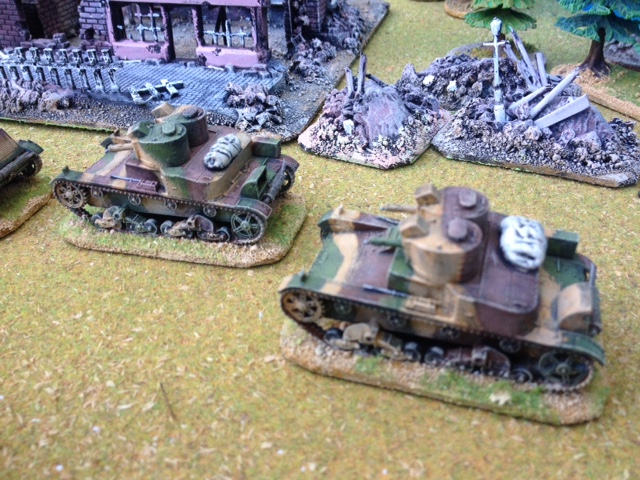
A 7TP tank looks for targets. This tank was better than most of its opponents but there were too few of them.

Twin Turreted Vickers E join the defense of father land.


TK3 looks big here but was probably the smallest tank(ette) of WWII.


WZ-34 armoured car with an ESCI French officer from their WWII soft plastic box.


The ruined city is made of old and trustable Matchbox parts glued together and with lots of grit around. Everything was black primed and then other colours were added from dark to light.

The First to Fight vehicles are very good and easy to built models. For wargaming though they have some fragile parts namely the MG's and main guns. In most cases I replaced them with a slightly thicker and more bendable Evergreen part.